


Economic fairness needs from now on to sit front-and-centre for Labour. This was the conclusion to the second of two pieces I wrote, North Stars and The Dead Centre, asking what went wrong for the Starmer government. For Labour to break out of the two bloc trap there must be a more overtly social democratic agenda.
This conclusion is easy to make, and I’m hardly the first to make it. Andy Burnham’s rise to power has been driven in large part by the same premise. But why is it so electorally important, and what does it mean in practice? The below article aims to address these questions.
Rationale
To begin, it’s worth recapping on the electoral logic – using three piece of evidence. The first is the chart below. Taken from an analysis by Ben Ansell, it depicts 2025 voting intention, overlaid onto the conventional political spectrum, and broken into different socioeconomic groupings. The size of the bubble in each case represents the size of the vote.
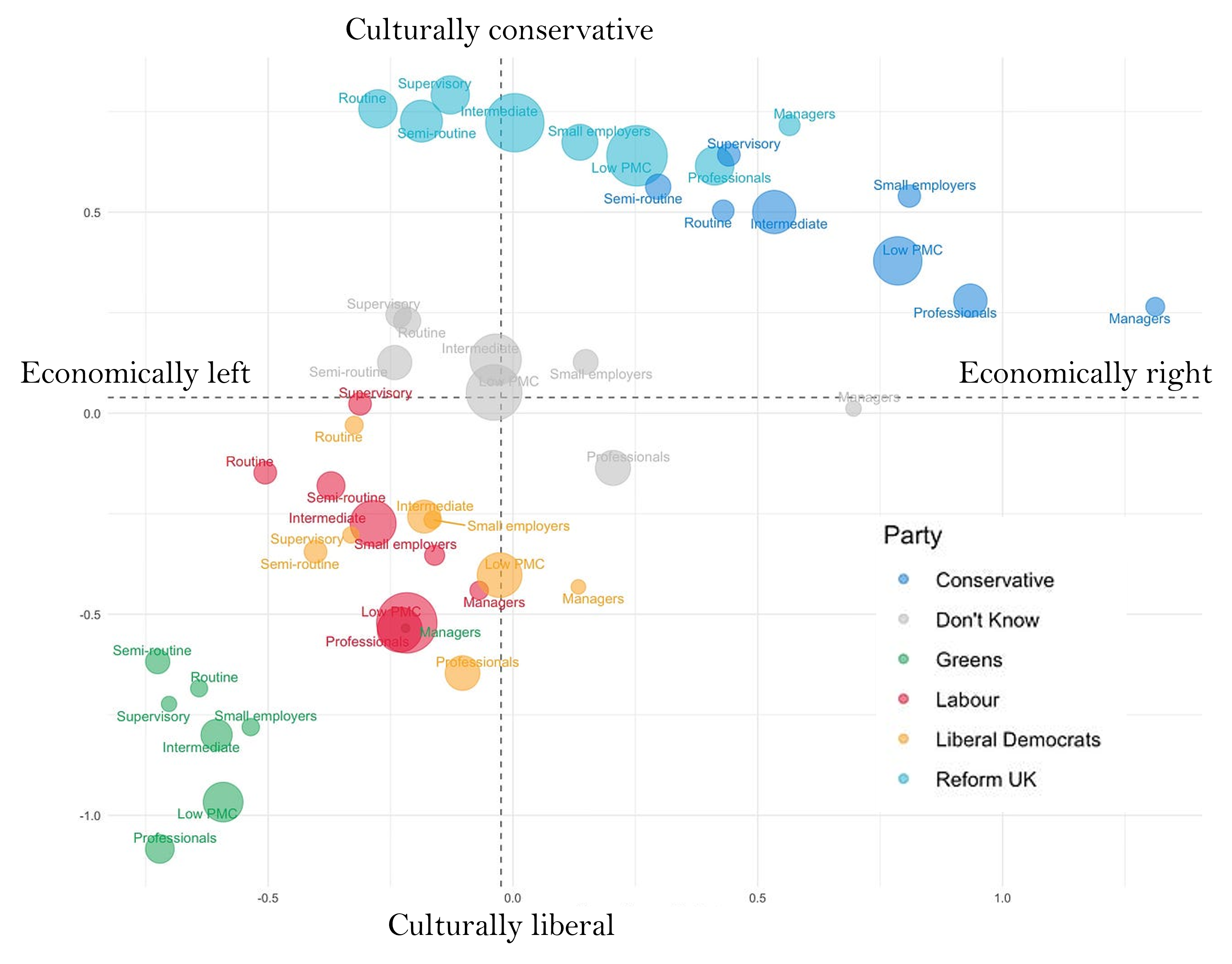
The chart shows that the two main parties of the right bloc, broadly speaking, are united on culture but divided on economics. Working-class Reform voters are a long way to the economic left of those in better-off class groups. Likewise with Tories. And Reform voters in general are to the economic left of Tory voters.
Voters for left bloc parties are the opposite: divided on culture but united on economics. Green voters from poorer social classes are less liberal than those from better-off classes, for example. But they’re in roughly the same place on economics. Class differences between the left bloc parties are likewise more acute on social issues than on economic ones.
Political debates focused on the economy are likely to unite the left bloc and split the right bloc, therefore. Political debates focused on social issues and immigration are likely to do the reverse.
The second piece of evidence reinforces this. Taken from a 2020 paper for UK in a Changing Europe, the chart below was published at a point when Starmer’s Labour was the primary left bloc option and Johnson’s Tories the primary right bloc option – their Red Wall coalition still intact. The graph shows where the two main parties’ politicians, activists and voters sat on the economic gamut.
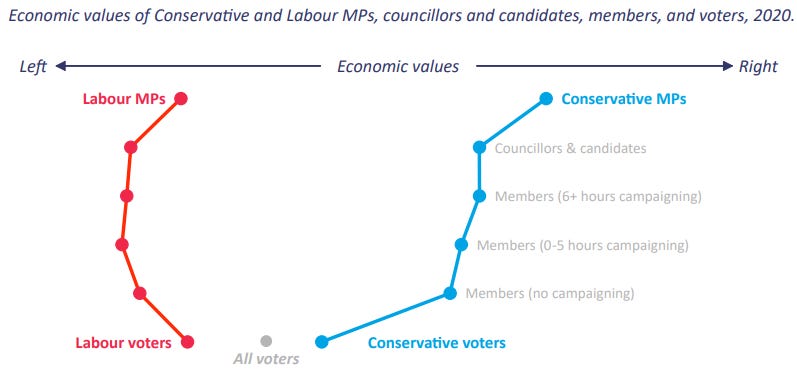
Whereas Labour were united on economics, from MPs down to voters, the Tories were worlds apart. Throughout the last parliament, their voter base was much more left-wing on the economy than their MPs – closer to Labour, in fact.
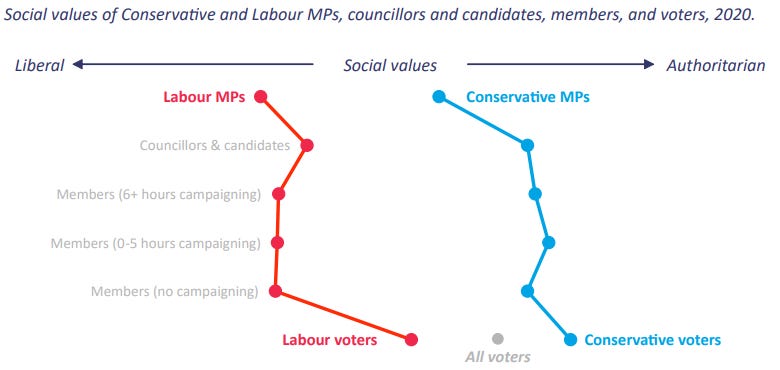
The next chart shows the same thing for social attitudes. Politicians were more liberal than those voting for them, in the case of both parties. But the overall stance of Conservative MPs was closest to that of the average voter. It was the Tories’ position on social issues which kept many in their camp, despite misgivings about Conservative economic policy.[1]
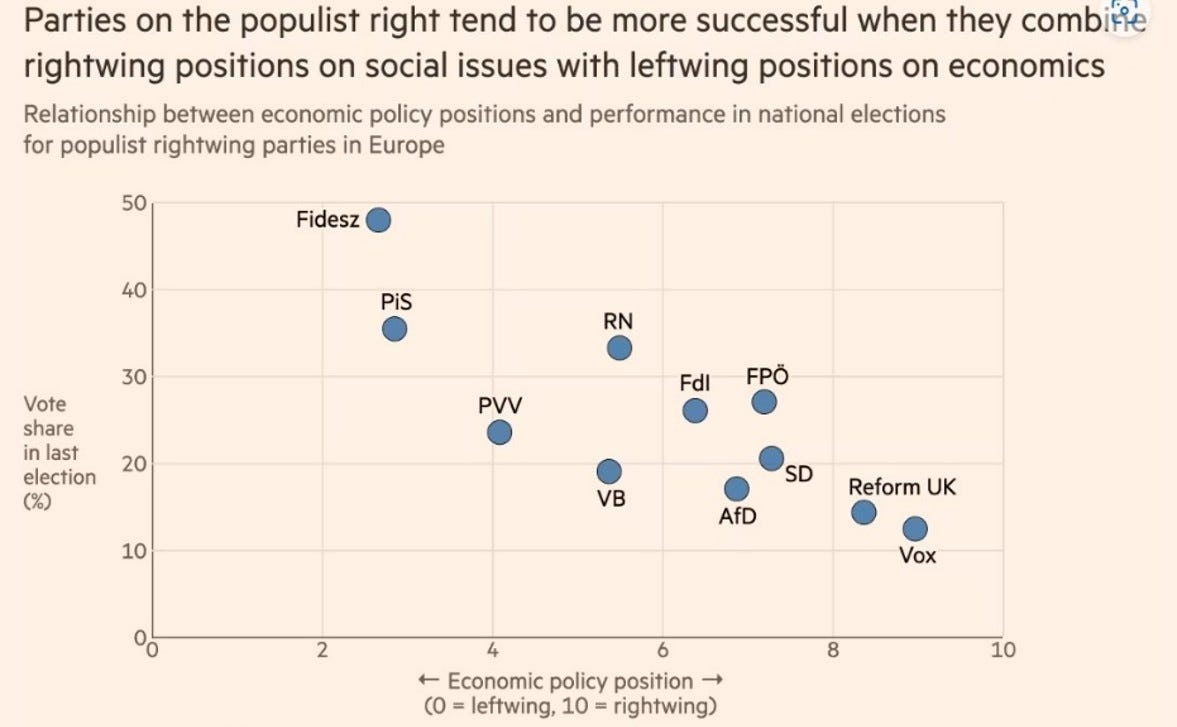
The third and final piece of evidence is the graph below. This looks at things from an international perspective. Produced by John Burn-Murdoch, in autumn 2024, it illustrates that anti-immigration parties with left-wing economics perform better at elections. As we can see, this is a problem for Reform – a party rooted in Thatcherism. Other radical right forces in Europe have historically taken more workerist stances, and have fared better.
It’s no surprise, in this light, that Farage and co began a concerted effort to present Reform as a party of the left after the 2024 election – championing nationalisation, ‘re-industrialisation’, and even the abolition of the two-child benefit cap. Nor is it a surprise that the period when they were able to maintain this façade coincided with their strongest sustained polling position.
In general, voters assume Reform are ‘for the working-classes’ (something they don’t say of any other party except Labour). Farage’s true positions on issues like the NHS come as a surprise. And Reform’s incoherence about these policy areas represents a weakness for them (especially given their increasingly public ties to big money). But exposing this relies on having a clear agenda for economic fairness yourself.
All of the charts above indicate, therefore, that left-of-centre economics are crucial – in breaking free of the two bloc trap and in puncturing the populist right bubble. For Labour in particular – the only progressive party with a historically working-class base and the only one with a raison d’etre based on collectivism – the policies must be there and must be talked about.
What’s left?
What does ‘shifting to the left on the economy’ mean? And isn’t it a huge risk? Large sections of the public still suspect that Labour is the party of welfare and debt, after all. Most floating voters are not socialists; instead they fall into the category which Jon Cruddas once described as ‘fiscally conservative but economically radical’. They espouse a raw feeling of economic injustice, alongside a suspicion of big business and a support for sharing resources.[2] But this doesn’t automatically translate into the economic policies which progressives favour.
Nationalisation, for instance, is expensive and seems to many to be cracking the wrong nut. Workers’ rights and minimum wage policies again don’t capture the mood of the ‘squeezed middle’. Social security is viewed with suspicion. Redistributive taxation is only really popular when the target is the super-rich. Keynesian economics is not intuitive, as it’s associated with borrowing and debt. Growth, localism and public sector reform all sound too technocratic. Etc.
If there exists a true spirit of economic fairness, I’d say it relates to something slightly broader than the policy levers listed: namely, a government willingness to intervene in the economy when it isn’t working. Voters of all political colours see prices spiralling, deep inequality and a broken social contract. They want the state to step in, when markets don’t deliver moral outcomes. And they assume it’s within the government’s gift to do so. Sometimes, this will involve the left-coded methods mentioned above. But at its core it’s simply about doing the right thing.
The Starmer administration’s failure on this front was a big part of the reason why his promise of ‘change’ curdled as it did. The rare flashes of popularity during his premiership related to policies like the crackdown on water companies, VAT on private schools and the banning of social media for under-16s. But the countervailing pressure to attract investment meant that Starmer’s government never strayed very far down this path – often appearing to passively wait for the next round of GDP figures.
The six zeitgeists
Rather than double down on some of the traditional left-wing methods described above (nationalisation, welfare etc), ‘leftism’ for Andy Burnham should involve setting out a series of economic ‘themes’ or agendas. These need to: a) be relatable and engage with the current ‘zeitgeist’; b) express a social democratic point-of-view about the country; c) cut across multiple policy areas; and d) override conventional economic arguments about GDP – treating the economy as a means to an end, to be shaped.
Below are six agendas which potentially do this, combining an ethos of fairness with a proactive state willing to step in. There are already very positive signs since Andy Burnham took over, in the case of many. But they need to be thought through and foregrounded as much as possible.
The first agenda is to tackle regional inequality head on. Focusing on this is clearly not a new idea, and has been central to Burnham’s diagnosis of the country. It cuts across the Brexit divides which govern the two bloc model, and has broad support.[3] This is a policy path which is littered with good intentions, however. Making a success of it means taking the argument beyond mere devolution – which is not linked to the economy in voters’ minds.[4] It also means avoiding the pitfalls of ‘north vs south’ or of regional populism. Geographical inequality undermines the whole UK, the argument must run – half the country can’t get a decent job, the other half can’t get a decent house. It’s not a case of haves and have nots.
The second agenda is championing the customer.[5] This is about Labour seeing the protection of consumers and customers as a calling every bit as important as the protection of workers. It is in their capacity as customers that UK voters are really feeling the pain right now. They have not thus far had a convincing political champion, Martin Lewis notwithstanding. Becoming this champion involves measures to tackle practices which irritate and exploit.[6] Burnham’s early steps in this area have wrongly been dismissed by some as “small fixes”. To punch their weight they must by pulled into a single public narrative, with an intellectual framework behind it: the government as the nation’s consumer watchdog. This won’t fix the cost-of-living crisis, but could make voters feel less like they’re on their own with it.
The third agenda is restoring communal life. COVID atomised society and accelerated the decline of shared spaces: the high street, the pub, the office, the gig, the football match, the youth club, even the shared TV channel. Policy levers in this area are thin on the ground, as some of the shifts simply reflect changes in people’s behaviour. But economics is at least part of the picture (hence why high streets in poorer areas tend to fare worse). The government could begin to look for a new, post-retail function for town centres, for instance. It could deliberately favour ‘communal’ organisations like pubs in the tax system, or could offer tax breaks to companies that make it easier to ‘speak to a human’. As with championing the consumer, this would involve a raft of small policies, under a larger banner.
The fourth agenda is protecting against AI. This is the issue of the hour, and swathes of the population worry it will render them obsolete. AI disciples, especially those in politics, have too often expressed their argument in terms of simply embracing the future. I’m not suggesting our leaders should seek to smash this new machine. But a government focused on fairness and economic intervention needs firstly to explain how it will mitigate the obvious threats which are posed by AI, at a time when the technology is moving incredibly fast. And it needs secondly to spell out what seizing the potential actually looks like. What are the new ‘AI jobs’ which will be created, for example, to replace those lost? Is UBI on the table if these new jobs don’t materialise?
The fifth agenda is re-weighting the economy towards income instead of wealth. The steady move towards an economy where what you stand to inherit counts more that your own endeavour is a disaster for social mobility. Rebalancing this in a cost-neutral way would carry support, at a broad level, amongst an electorate who see their grown-up children unable to get on the property ladder. Policy-making would need to tread extremely carefully here. But tax on land or capital gains (such as the policy proposed by Wes Streeting in May) would offer a start. This is both the most left-wing of the themes, and the one most open to Thatcherite or at least Blairite framing – based as it is on reconnecting effort to reward.
The sixth agenda is infilling the journey from cradle to grave. This contains four sub-themes; four aspects of the modern journey through life which the post-war consensus did not legislate for. Each of these is based on one of the key junctures where a coherent safety net doesn’t presently exist. These are as follows:
Those amongst the 18-24 age group who do not go to university. This has been high profile of late, thanks to the related rise of the NEET issue. In the industrial economy of 1945, the prospects for this age group were completely different. With fewer and fewer ‘first jobs’, a new set of pathways or institutions is needed.
Parents of children under 5. In an economy where it requires both parents to work, to realistically cover the costs of childcare, the absence of reliable early years state provision undermines both socio-economic and gender equality.
Older people in need of social care. Again, this was not a factor in the same way 80 years ago. But with an ageing population it has become a source both of vast state expense and of engrained inequality.
Those of all ages struggling with mental health. Our understanding of this is in a completely different place to in 1945. The NHS provision of mental healthcare is currently negligible, compared to that for physical support, and means that people across a range of ages fall through the cracks.
The four aspects of the cradle to grave are somewhat piecemeal. But they’re united by the desire to modernise and upgrade the Attlee government’s frayed legacy.
Conclusion
I am not proposing the above as the sorts of pledges or targets that could become hostages to fortune. They cannot all be pursued at once. Policy limits mean some are very long-term projects, where early stages must be incremental.
But the agendas in question tap into a set of genuine economic concerns, cutting across society and across voter groups. Labour needs to show that it cares about them and is thinking about them, and to start talking about this. The six zeitgeists allow an overtly social democratic conversation to take place, without Labour falling into the usual left-wing pitfalls, but also without the party appearing to become relegated to the status of passive observers of the economy, as it was under Starmer.
Notes
[1] These two charts reflect the core challenge for Starmer, prior to 2024. In short, he needed to dramatically kerb some of the activist excesses and cultural grandstanding, which had reached the top of the party under Corbyn. But he needed to hold firm on Labour’s social democratic credentials.
[2] The questions used to situate people on the economic spectrums in the charts are as follows: ‘government should redistribute income from those who are better off to those who are less well off’; ‘big business takes advantage of ordinary people’; ‘ordinary working people do not get their fair share of the nation’s wealth’; ‘there is one law for the rich and one for the poor’; ‘management will always try to get the better of employees if it gets the chance’.
[3] It’s worth noting that arguments about inequality between places unite people (p.11-14), in a way that arguments about inequality between individuals do not.
[4] Specifically, there needs to be explanation of how more layers of politicians means more jobs or industries. What does the economic future look like for coastal communities or ex-industrial areas, for example, with or without a devolved mayor? What will drive the new economies in these places? What will they sell, make or do? The idea that local politicians know how to spend money better only half answers the question here, especially for people with poor experiences of their own local council.
[5] This is not to be confused with retail politics, the separate and unrelated practice of treating voters like customers, and offering them policy incentives to vote for you – famously mocked by David Axelrod as ‘vote Labour, win a microwave’.
[6] This could mean naming and shaming practices like ‘shrinkflation’; regulating against surge pricing and price-fixing; outlawing hidden fees; embedding decent complaints and refund procedures for train and plane companies; streamlining of certain sectors (e.g. parking apps); offering independent oversight of sectors like vets, so people aren’t paying for services they don’t need, etc. Lastly, it needs to mean the state and the private sector leading by example in all of the above areas.