

‘Getting Things Done’
Southgate, leadership, and the Gordian Knot

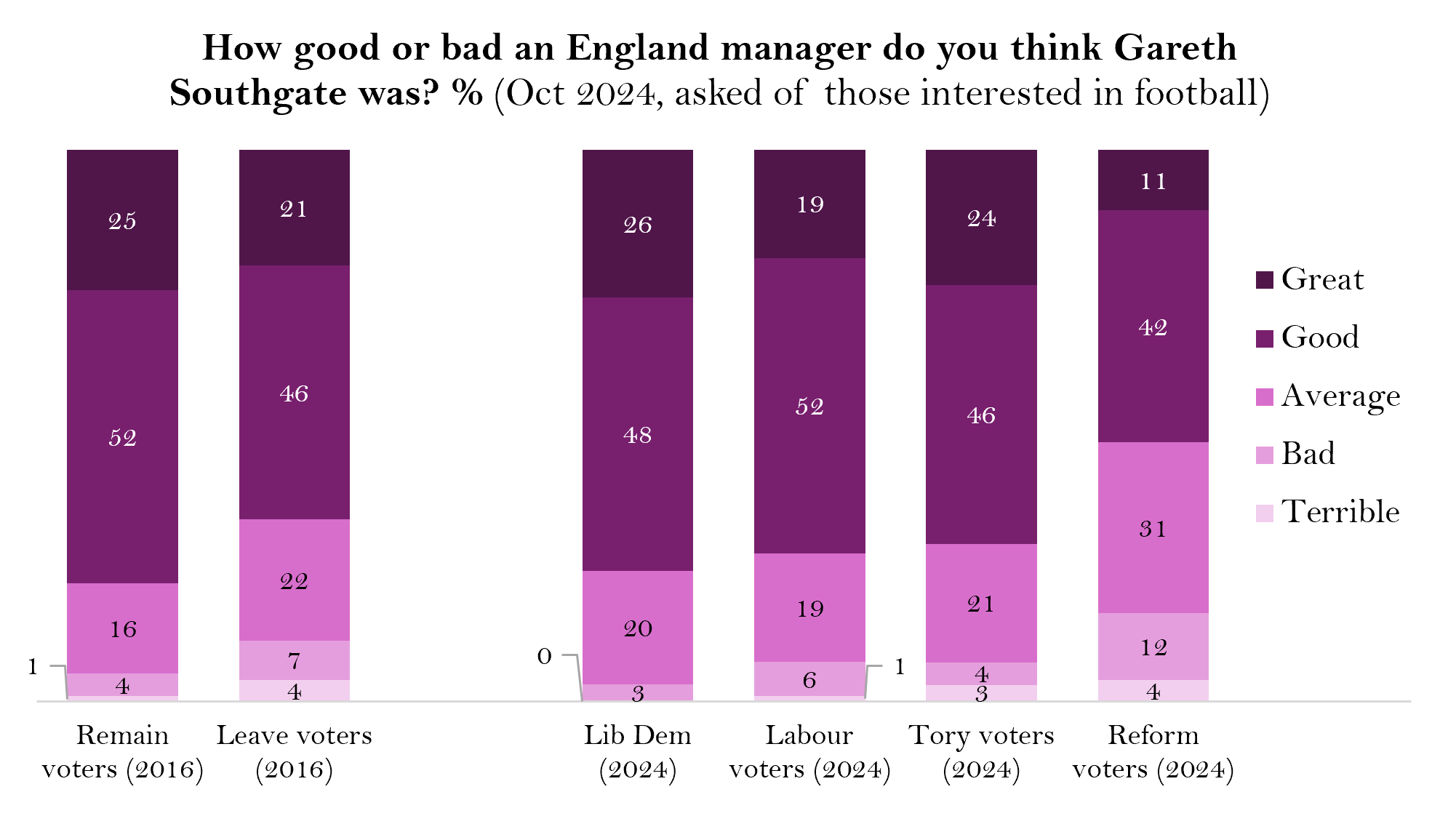
Shortly after Gareth Southgate left the England manager’s job in 2024, YouGov polled the public on their views of his tenure. Despite prior frustration in some quarters, the verdict was positive. Southgate’s record in major tournaments is hard to argue with, and 69% of those who knew enough about football to venture an opinion ranked him ‘good’ or ‘great’.
Yet the political cross-tabs in the data revealed an interesting sub-plot. As the chart below shows, Leave voters were less likely than Remain voters to rate Southgate positively. And this gap became more pronounced once you drilled down to individual party supporters – with 2024 Reform voters the most luke-warm and 2024 Lib Dems the most overtly positive.
This reflects a consistent pattern in terms of attitudes to the then England manager. This was evident before England lost to Spain in the Euro 2024 final, and in fact went back several years before that.
Leave voters were much more hostile than Remain voters about the prospect of a Gareth Southgate knighthood, for instance, when asked in 2021. And they were similarly sceptical about him getting the honour three years later, in 2024. In every available poll, including when Team England were at the peak of their powers, favourability towards Southgate among Leave voters lagged behind that with Remain supporters.
This skew is interesting to ponder during World Cup season – with James Graham’s state-of-the-nation drama Dear England regularly trailed on iPlayer, and with Southgate’s Lessons in Leadership topping the Waterstones bestseller list. But I think it carries wider implications about political leadership too, a decade on from Brexit. As Andy Burnham prepares to enter Downing Street, it’s worth considering why there would be such a strong political dimension to Southgate’s appeal – and what this says about the style of leadership needed to finally unite the 2016 divides.
Part of the answer to the Southgate conundrum is explained by the culture war debates after 2020, of course, which formed the backdrop to his time as manager. Southgate adopted a clear liberal position on questions like taking the knee, most famously with his 2021 open letter. And whilst his interventions were generally tempered by a support for the monarchy, the military and the nation state, there may be some on the anti-‘woke’ right who never forgave him for this.
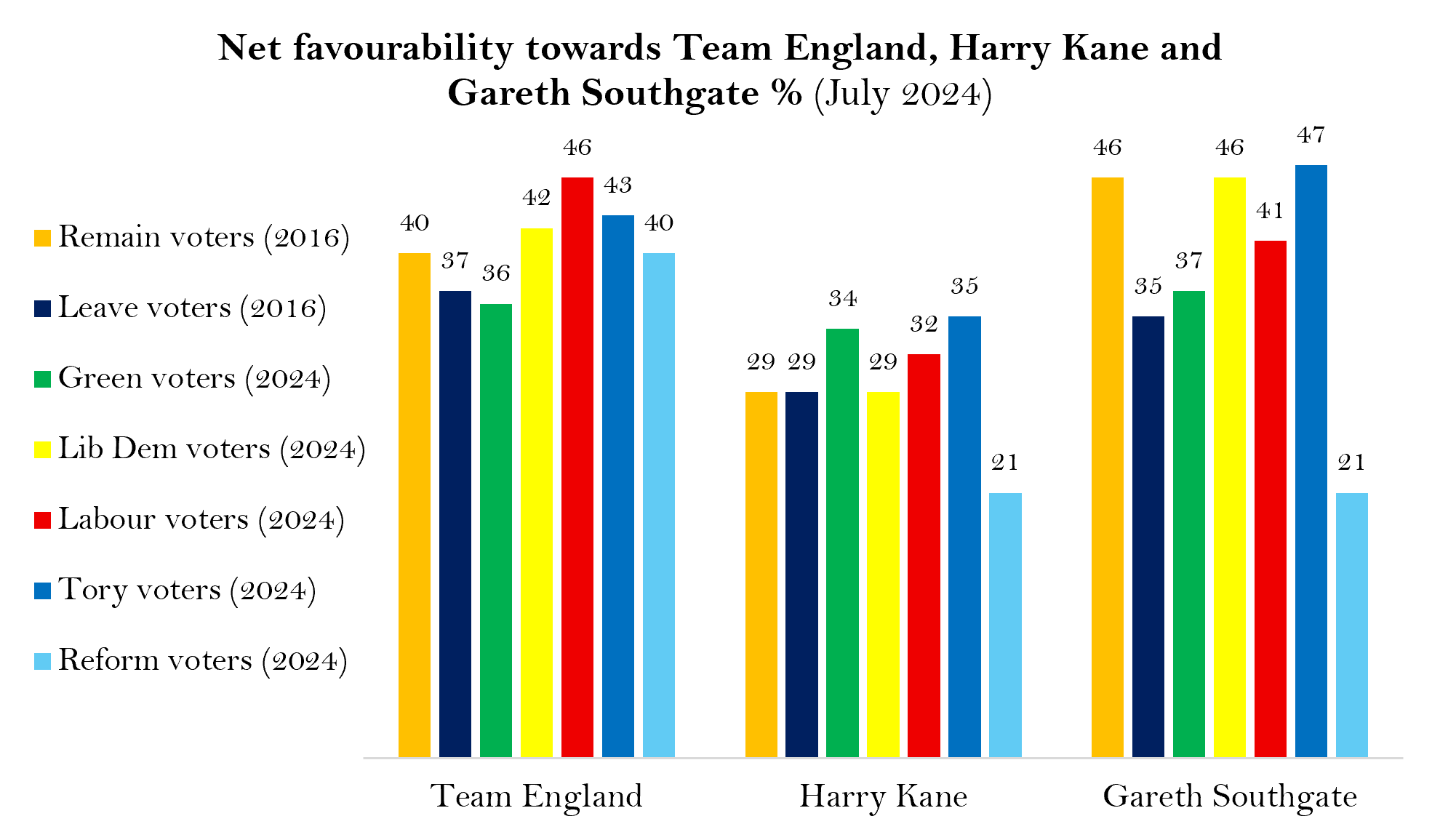
Yet this is only part of the picture. England captain Harry Kane was at least as publicly supportive of Black Lives Matter and LGBT rights, for instance, yet when his favourability was polled by YouGov, alongside Southgate’s, the political patterns were much milder (as the chart above shows). A disdain among Reform supporters notwithstanding, favourability towards Kane barely correlated with politics.
The true cause of the Southgate disparity, in my view, is about style of leadership. How are results achieved by those at the top?[1] And what are the personal qualities which matter most in delivering them? People with contrasting politics often have dramatically different views about how you ‘get things done’.
To dig into this, it’s worth exploring a report published late last year, by Professor Tim Bale and colleagues, as part of the Party Members Project. Amongst many fascinating insights, the paper includes a section on the specific leadership traits which members of the five main parties look for.
This identifies stark differences between the attributes sought by members of right bloc parties (the Tories and Reform), and those sought by members of left bloc parties (Labour, Greens and Lib Dems). The former place much more emphasis on strength, ability to ‘stand up’ for Britain, and preparedness to break the rules. The latter are much more focused on their leader having a clear ‘moral compass’.
Indeed, the Party Members Project analysis explicitly asked about the so-called ‘dark triad’ of personality traits – sub-clinical psychopathy, Machiavellianism and narcissism. Members of the Conservative Party and Reform UK were much more likely than members of Labour, the Lib Dems or the Greens to see these characteristics as assets for a leader (see charts below).
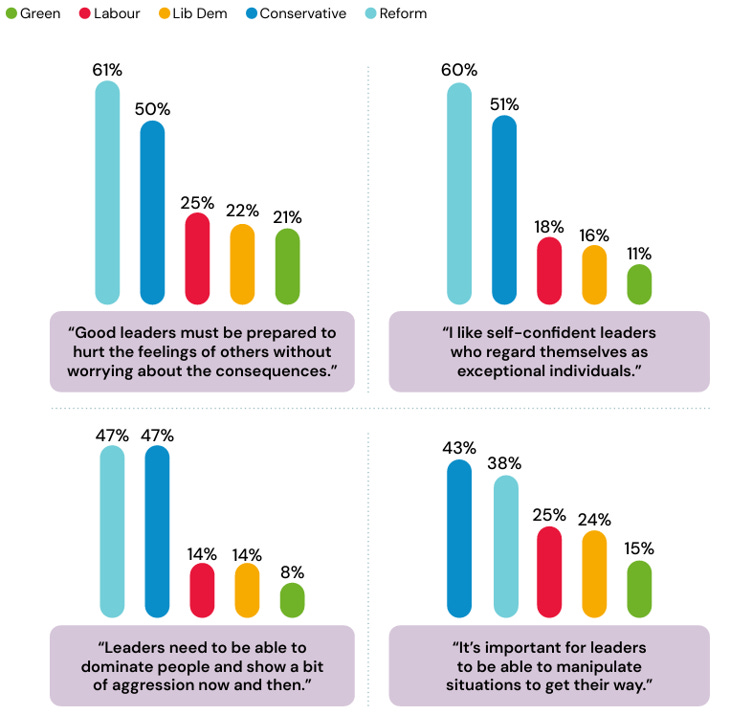
This helps us make sense of the Southgate conundrum. Gareth Southgate was the antithesis of the ‘dark triad’ persona in question, of course (as Joseph Fiennes’s twitchy and self-effacing portrayal captures in Dear England). He rejected the spirit of national exceptionalism that he believed had hampered the national team up to that point, and sought to get the best out of his players by understanding them as people.
For those on the liberal left, the fact that this yielded results on the pitch was a vindication. But for those on the political right, Southgate was the wrong type of manager. A nice guy, many would agree. But not a leader.
Hence, I’d speculate, impatience set in more quickly amongst this political grouping, with performances on the pitch judged more harshly.[2]
Progressives may take the Party Members Project findings as proof that members of right-wing parties are immoral or irrational. And it’s true that some of their attitudes to leadership are hard to fathom. But in my view something subtler is going on.
Over the course of countless focus groups, one of the most common questions I have found myself asking swing voters is the ‘ideal leader’ question. “If you could choose someone from outside politics to be Prime Minister/ your local MP, who would it be?”
Tory- and Reform-friendly swing-voters are often the participants in these focus groups. And the ‘ideal leaders’ who they tend to choose have a standout trait in common: they’re exceptionally forthright, with big egos and a ‘warts-and-all’ approach which verges on the abrasive. Examples include Tim Martin, Piers Morgan, Alan Sugar and (at one point) Elon Musk.[3]
The selling point for these individuals is not that they’re likeable, so much as that they’re seen as the sorts of uncompromising characters who make things happen. They have the traits necessary to cut the Gordian Knot, voters think – the complex web of problems, to which there ought to be a simple solution. They have what it takes to bludgeon their way past a parliamentary committee, a council talking shop, or a barrage of red tape, through sheer force of personality.
These same traits are projected by socially conservative or right-of-centre voters onto some politicians – especially those who behave badly or spark outrage. Whenever I’ve heard Boris Johnson, Nigel Farage or even Donald Trump praised in the past, it’s usually on the basis that, ‘love them or hate them’, they get things done.
Indeed, the offensive or corrupt behaviours which the left seizes upon as ammunition against these individuals are, in a sense, part of the appeal. This is not because these behaviours are seen as positive in themselves by those who are drawn to Farage and co, or because these voters embrace all misconduct. (It was the hypocrisy of Party-Gate which brought down Boris Johnson, after all). But controversial stances and glaring personal flaws can indicate, to a certain audience, that these types of leaders will not be cowed.
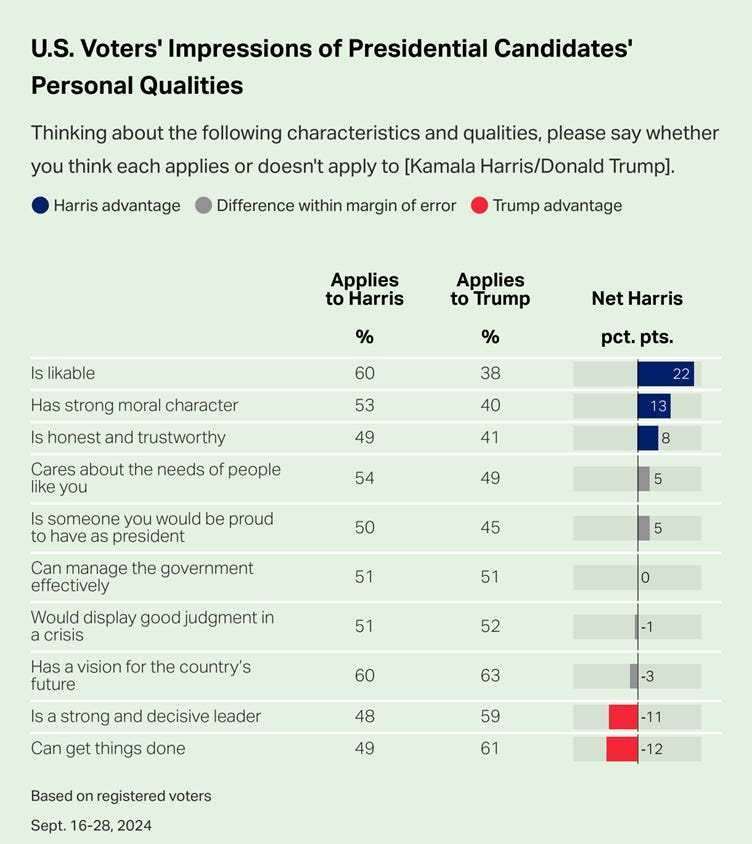
With Donald Trump, this perception is especially acute. 2024 pre-election polling in the US found that Trump trailed Kamala Harris for characteristics such as likeability, morality, trustworthiness, being ‘on my side’ and even ‘having [the] personality and leadership qualities a president should have’. But, as the chart below shows, Trump possessed a clear advantage over Harris when it came to ‘strength’ and ‘getting things done’. And for a certain group of voters in swing states, this was what counted.
Even for voters in the UK, this perception of Trump lingers. People may describe him as ‘dangerous’ or ‘unhinged’, but they often caveat that he gets things done.
Why do these differences between political leanings exist in the first place? My own hypothesis, which I wrote about a few years ago, was that they can be understood using George Lakoff’s psychological distinction, between ‘direct’ and ‘systemic’ causal reasoning. Social conservatives take an A+B=C approach, for instance, based on personal responsibility and not overthinking problems (i.e. ‘toughness on crime’). Liberals, by contrast, blame underlying factors and structural reasons (i.e. ‘toughness on the causes of crime’).[4]
At its worst, this can lead the right to take a ‘great man’ theory of history or a ‘strong man’ theory of politics. But direct reasoning is not always without merit. Sometimes, such as with Winston Churchill in 1939, leadership must display the clarity and gumption which the right prefers. In the immediate aftermath of a terror attack or natural disaster, direct causation is often vital before you can start to contemplate root causes.
At present, however, it seems obvious to me that the UK’s problems are complex, requiring long-term solutions and detailed structural changes. Successive governments have failed to fix these issues, despite large majorities. And, whilst a series of Prime Ministers over the past few years have presented themselves as men or women of action – ready to ‘get things done’ in the face of lily-livered opposition – they have generally found that willpower alone is not enough.
There is no way to cut our current Gordian Knot, in short. The type of leader we require right now is someone ready to sit down and start disentangling it.
In the end, Gareth Southgate’s time at the helm of England was highly successful, in spite of the deep misgivings among social conservatives which I’ve described above. Even among Reform voters, who were by far the least positive about him, more than half ultimately acknowledged that he’d been a ‘good’ or ‘great’ manager. They were kept onside for four tournaments, just about.
Football is not politics, but the reasons for this are worth examining before we conclude. Firstly, Southgate did not pretend to be the type of chest-thumping manager which certain sections of opinion might have preferred. In this he was authentic, and won grudging respect.
Secondly, he clearly had a diagnosis and a set of answers about the England team, about which he’d given very serious thought. Hence, he was able to manage expectations and explain where he was going – especially once the results started to go his way. Even those who did not particularly like his style of leadership could see a methodology at work.
Andy Burnham’s return to parliament came via Makerfield, a socially conservative and Reform-friendly seat, yet his political positioning has generally involved a direct appeal to left bloc voters and progressive values. This has given hope to many, that Burnham can unite these groups under a political agenda, in a way that Keir Starmer could not. The Southgate model offers a potential settlement, achieved not by aping the leadership styles of the right, but by demonstrating that there’s another way to ‘get things done’.
Notes
[1] The original poll cited also asked about the characteristics required by Southgate’s successor, for instance. It found that 2024 Reform voters were more likely than supporters of other parties to mention ‘desire to win’ as an important trait. They were less likely, meanwhile, to value technical attributes, like competence, experience and leadership skills.
[2] It is worth noting here that, whilst Tory members appear to admire dark tried traits, it’s not clear that their 2024 Tory voters feel the same way. Certainly, Tory voters are much less negative towards Southgate’s style of leadership than Reform voters.
[3] An outlier here is Martin Lewis. He also comes up very frequently, but I’d argue that he is trusted for slightly different reasons.
[4] It’s for this reason that I have generally spoken of ‘liberal-conservative’ rather than ‘left-right’ here. The realignment towards the former pole in recent years has run through the centre of both main parties, with the cleavage tending to be based on those who favour complex ‘systemic’ explanations versus those who favour simpler ‘direct’ ones.