



How do you govern in a centre left way, at a time of economic hardship? This is the question John Healey will attempt to answer in two weeks’ time. It’s one which Keir Starmer and Rachel Reeves failed to resolve, to their ultimate cost. And it’s the dilemma which many fear (or in some cases hope) will pour a bucket of cold water over Andy Burnham’s message of optimism.
There are two public narratives, never far from the surface in a straitened era, which make it hard for social democrats to get the answer right. The first is the narrative of scarcity – of hunkering down, of belt-tightening and wagon-circling. The second is the narrative of unfairness – of whether the resources we have are divvied up correctly, and of why some have it so much easier than others. Just about all economic decisions will be seen through these lenses.
The chart below shows how voter groups in Britain weigh up the respective frames. It’s based on a fascinating piece of large-sample polling by the Good Growth Foundation (GGF), due out later this year.
On the horizontal axis are opinions about scarcity. Voters for parties which are further to the ‘west’ on GGF’s spectrum believe there’s not enough to go round, and those further to the ‘east’ say there’s enough. We can see that Reform and Restore voters, in particular, see resources as limited.
On the vertical axis, meanwhile, are opinions about fairness. Voters for parties towards the ‘north’ say our economy is not fair, and those further ‘south’ say that it is. Generally speaking, voters for the three established parties (Labour, the Lib Dems and the Tories) are less likely to say society is unfair, and voters for insurgent parties (be it the SNP, the Greens or Reform) are more likely.
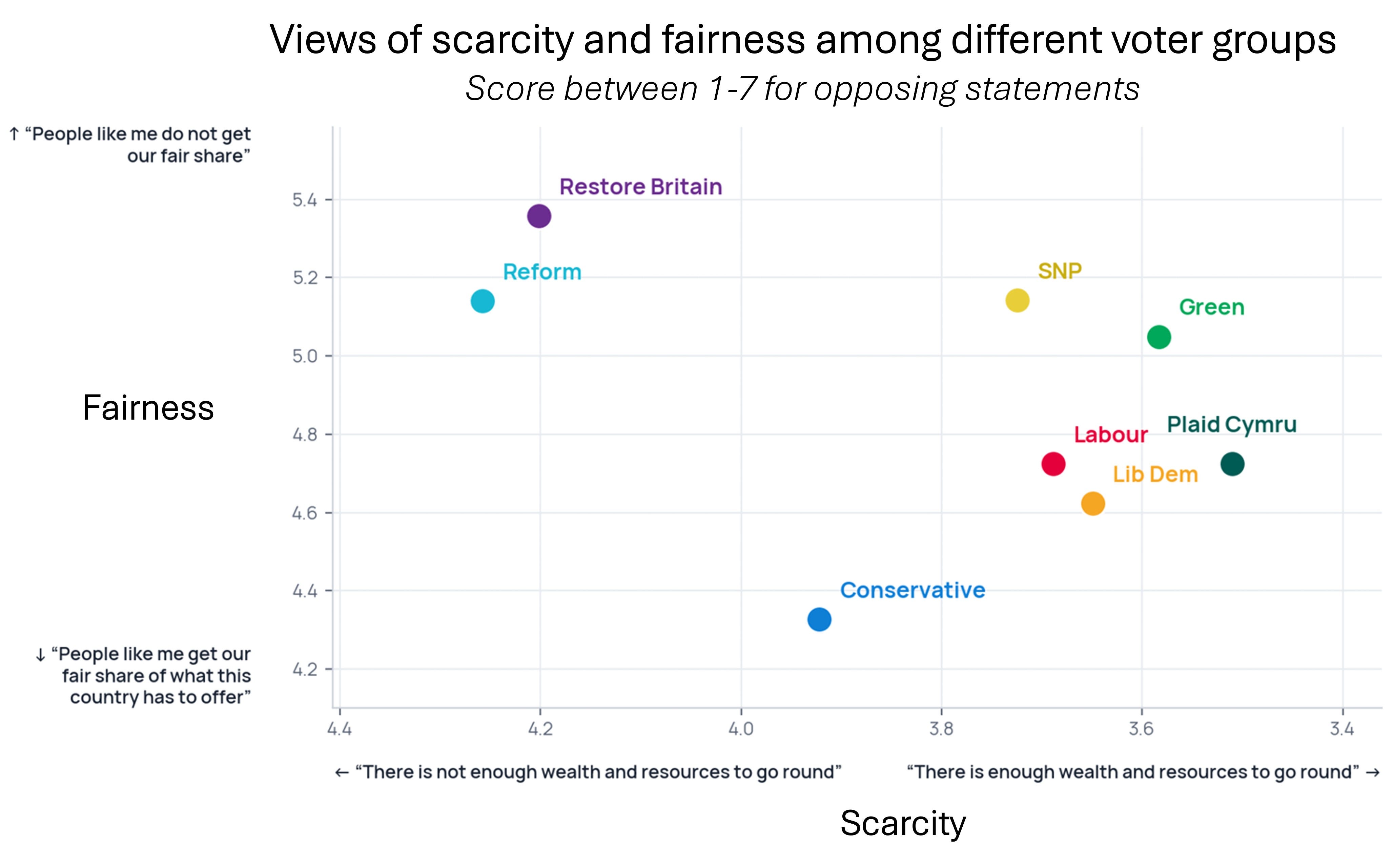
When they previously polled this question, in the last weeks of the Keir Starmer premiership, GGF found that Labour’s ‘dot’ was notably further ‘south west’ than it is now – and that the Greens’ was further ‘north east’. In other words, Andy Burnham has brought back into the Labour fold many of those on the political left, who are most concerned about economic unfairness and least convinced by scarcity narratives.[1]
The implications of the chart above go beyond immediate questions of party politics, however. They reveal the core psyches which govern how people vote – and how they’re likely to respond to economic policy.
The obvious standout element in the chart is the extent to which the right populist parties, Restore and Reform, are in a completely different place to anyone else, when it comes to scarcity. They see a small island, a shrinking pie. This defines their politics. It means they’re radicals, rather than steady-as-you-go conservatives: they believe that protecting and rationing the pie must trump all else.
This is reflected in a view of migration which says that more people means less to go round. When times are this hard, the right populist logic runs, the admittance of even a single extra person comes at the expense of someone already here. Immigration is the economy. Clearly there’s overt racism in the ranks of both parties. But the surge in their appeal since 2024 derives primarily, in my view, from the attraction which this ‘one in one out’ logic has – for sections of opinion which would often not see themselves as nativist or xenophobic.
The scarcity perception of the populist right goes beyond migration, though. It usually subscribes to the ‘household budget’ view of the economy, and fears that freeloaders will drain our resources. It opposes borrowing – for fear of ‘robbing Peter to pay Paul’ – and takes a more supportive line than any other party’s support base, when it comes to hardline welfare policies like the two-child benefit cap. Waste is spied everywhere, with a desire to strip back or to make do and mend.
This explains why other parties’ efforts to win back those drawn to the right populist sirens have usually failed. Doing so often requires extreme measures, which will not only alarm everyone not currently intending to vote Reform or Restore, but which also run directly counter to many of the pragmatic steps the country needs. The zero-sum logic of the scarcity narrative is consistently at odds with the positive-sum logic of a growing economy. Mainstream parties find themselves unable to follow through on it.
The right populist prospectus described above is hardly a progressive one. So it might come as a surprise that Restore and Reform are as exercised about economic unfairness as they are, according to GGF’s chart. Tory strategists, in particular, will look with trepidation at the impassable gulf on this issue, between their voters and those of the other right bloc parties. The enduring Conservative appeal, since 2024, is amongst the relatively unusual group who believe the society we live in is fair.
Green and SNP voters, meanwhile, may be surprised to learn that right populist voters have an even greater feeling of economic injustice than they do. Right populist parties’ voters are firmly in the redistributive ‘northern hemisphere’ – higher than the left parties or progressive nationalist parties, on this question. This is not reflected in the policies backed by Restore or Reform, less still in their leaders’ ultra-Thatcherite hinterlands. As soon as attention turns to the economy, both right populist parties are vulnerable.
The grounds for right and left populists’ senses of unfairness are tonally different, it’s worth noting. For example, whereas the above graph uses a definition of unfairness based on ‘people like me’, the one below couches the same statement in the third person (‘wealth and resources are not shared fairly’). Left populist voters become more exercised about unfairness when it’s talked of in this neutral or abstract way, and right populist voters become less so (although the latter are still at least as worried as Labour or Lib Dem voters about it).[2]
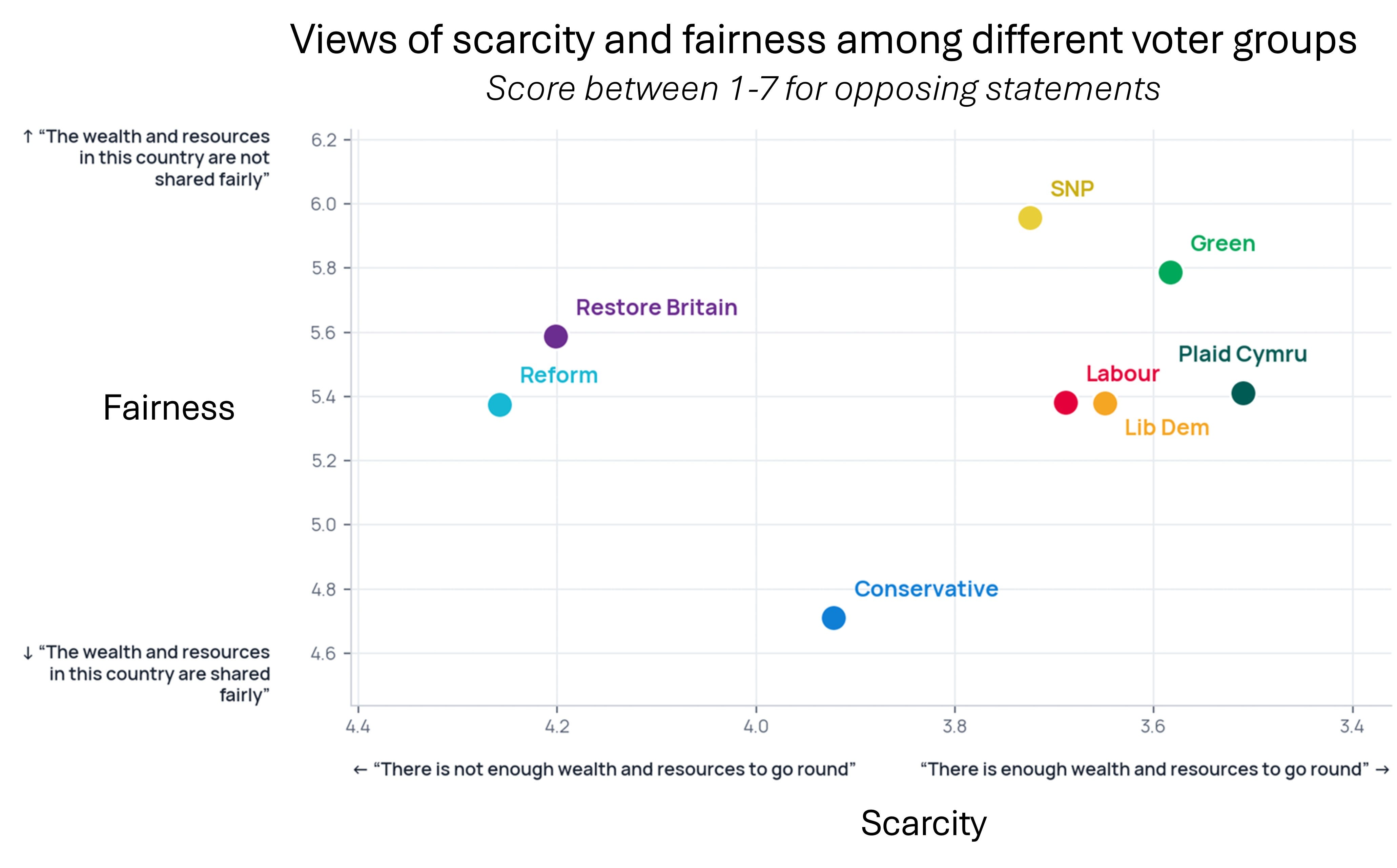
It’s the scarcity question which really takes right and left populist voters in different policy directions, however. Hence why a common cause between the Greens and Reform is unlikely to emerge any time soon, however much they both want to see the gap between rich and poor closed.
Reform and Green switchers will often, in focus groups, lament the state of the country, on a basis which is progressive: be it about the reliance on food banks, the length NHS waiting lists, the increase in homelessness, the paucity of mental health provision or the lack of pathways for young people. Reform voters, however, will often say the answer is to limit demand. Not just by stopping migration, but through hardline steps on things like welfare and A&E usage (to crack down on malingerers) or by cutting international aid. They’ll happily criticise the rich and the super-rich, but believe charity begins at home and want the ‘leaks in the boat’ mended first.
Green-inclined voters are the opposite, and object to such measures as mean-spirited and gratuitous. They see things through the prism of plenty: our economy has more than enough to solve the long list of problems we face, but it’s trapped in the bank accounts of a wealthy few. This too is a zero-sum politics, albeit of a very different kind. It’s focused on moving around the resources that exist, and tends to dismiss growth as a code word for conservatism.
The left populist’s outlook is one which I’m more sympathetic to than the right’s, especially when it comes to taxing wealth. But it can quickly morph into a view that redistribution from the 1% is a) easy to do, b) enough by itself and c) an immediate panacea, which allows you to park all other economic questions. The government could ‘make it rain’, if only they were willing to upset their millionaire friends.[3]
To a right populist voter concerned about scarcity, the largess and indifference to waste of the progressive left is unfathomable. It is put down to a lack of common sense or real world experience. Hence why the accusation that the left cannot live within its means is such an effective way of splitting the voters in the ‘northern hemisphere’ of our charts.
There is a path through, which can unite the concerns about unfairness which ‘scarcity’ voters have with those held by ‘non-scarcity’ voters. What is crucial is to be willing to talk about unfairness and inequality as a problem, and to show that the state will intervene to close the gap and prevent bad outcomes. The economy is something we can control. But this needs to be done via a form of progressive politics which is fortified against the ‘magic money tree’ characterisation – especially on the topics of welfare and borrowing.
I wrote about the methods for doing this this a couple of weeks ago, and in my view the Andy Burnham government is in very much the correct place. Ending the triple-lock to pay for adult social care is a good example of how you square the circle – deploying the language of priorities and framing choices as a swap. The success of John Healey’s budget will depend on similar formulations.
That the Starmer administrations never tried this approach is one of the curious aspects of Labour’s first two years in office. They persistently emphasised that the country was not broken, talked little of fairness, and appeared to treat the management if the economy as a technical exercise rather than something governed by values. Even as Labour hemorrhaged voters to Reform and the Greens, the government did not deviate from this. Keir Starmer’s response was instead to toggle his positions on migration and social issues in one direction or another. Hence, the electorate Labour ended up with, by the time of Keir Starmer’s departure, was firmly in the ‘southern hemisphere’ of the charts above, and was really quite comfortably off.
It’s hard to know whether the rationale for this was psephological or economic – an electoral fear of losing ‘shy Tory’ types, or a concern that economic intervention would look ‘anti-business’ and dampen growth.
The deduction made by the Burnham administration has very clearly been that these considerations are less important than Starmerites imagined, or at least that they’re less important than rebuilding Labour’s coaliton of economically insecure voters. I am sympathetic to this deduction. But the next few months will put it to the test.
[1] The June iteration also saw the Tory support base positioned closer to the ‘western’, scarcity poll. Their shift towards the ‘east’ during the period since potentially indicates more liberal or pro-growth Tories coming back onboard.
[2] This potentially reflects the fact that right populist voters may be more likely to be struggling personally. But it also probably feeds off the specific type of identity politics in which Farage and Lowe specialise, rooted as it is in grievance.
[3] The SNP voter’s rationale is slightly different here, I would say, with more emphasis on the idea that the resources of England or London could solve Scotland’s economic problems.