


This is the second of two opinion pieces attempting to unpack what happened to the Starmer premiership. The first piece, North Stars, can be read here.

“There are moderates, but there is no ideology of the moderate… A moderate conservative has some progressive positions on issues, though they vary from person to person. Similarly, a moderate progressive has some conservative positions… In short, moderates have both political moral worldviews, but mostly use one of them. Those two moral worldviews in general contradict each other.”
The above analysis was made by the American psychologist George Lakoff a decade ago. It referred to a US politics split along lines of culture, but it came against a backdrop of UK speculation about a ‘centre party’, comprising moderates from left and right.
When this phenomenon eventually materialised, in the form of the Change UK breakaway, Lakoff was proven correct. Former Labour and Conservative politicians struggled to unite around a single platform, despite their respective frustrations with Corbyn and Brexit. No values or electoral base existed for their project. They were stuck in the dead centre.
Keir Starmer’s premature departure as Prime Minister can be seen through this lens. His government found itself in the unloved middle, hemorrhaging support to left and right alike at the local elections in May. Labour’s 2024 watchword, like the 2018 breakaway party, was ‘change’. Yet it too struggled to articulate what this meant.
Centrism
Whereas my article yesterday dug into the policy quandary Labour faced in office, this piece explores the electoral aspect of Starmerism’s demise. But to begin with, it’s necessary to quickly define centrism and explain why it’s struggled in recent years.
There are some ‘ideological centrists’ who’d reject entirely the Lakoff quote above, believing that centrism exists as a distinct ideology and is the answer. Tony Blair himself wrote passionately about the potential of the ‘radical centre’ just a few months ago.[1]
There’s a second, wider approach, though, which I’d call ‘electoral centrism’. It’s this which I am really talking about here. Electoral centrism argues that you win from the centre; if you lose it’s because you have not ventured far enough from your comfort zone. You triumph by sticking to the bread-and-butter issues which motivate swing voters.
I have always been sympathetic to this view. It is impossible to win by speaking only to a small tribe or select group, and I hated the self-indulgence of Corbynism, with its rallies to the converted. But I also wonder if electoral centrism needs to be reevaluated or at least brought up to date. The lesson of Labour’s first two years in office was that it’s now much harder to please both sides, and that a politics which sidesteps values altogether brings diminishing returns.
The end of tribalism
Two long-term shifts have altered the context for ‘electoral centrism’. The first is that party tribalism has been in retreat for many decades. At almost every General Election since WW2, more people switched parties than did so at the one before.
The story can be simplified into three chapters. Firstly, during the post-war decades, class allegiance determined politics; a major imperative was simply to mobilise the base. Secondly, from about the 1970s, a larger proportion of voters began to be ‘in play’, as the class structure changed; centrist techniques for attracting swing voters became steadily more important. Thirdly, starting in the 2000s and accelerating in the 2010s, the remaining tribal loyalties faded. Electoral centrism had to work harder to keep its head above water, and became the bogeyman for a new identity politics. Left and right populists attacked it as technocratic and devoid of values.
The decline in party loyalty has seen a corresponding increase in the number of parties which are competitive. It means that no voter can now be taken for granted, banked or squeezed – as the various ‘walls’ that have fallen over the last decade illustrate. Without a core base to rely upon, many of the assumptions of ‘electoral centrism’ become defunct.
Peter Kellner’s ice-cream van analogy is the best metaphor I’ve come across for this. Kellner imagines the current political spectrum as a set of ice-cream vans parked along a beach, vying for customers.
In the past, when there were just two ice-cream vans, it made sense to place yourself towards the middle of the beach, monopolising customers all the way from the centre to the far end. When there are four or five ice-cream vans, however, the above strategy runs the risk that you’re outflanked by another ice-cream van, parked closer to your traditional base. In essence, there is now a danger that by being too close to the middle you actually lose ‘customers’.
The realignment
The second shift in the context for centrism is the much-discussed realignment. Brought into the open by Brexit, this moved the terrain of political contest away from economics and towards social issues, culture and immigration.
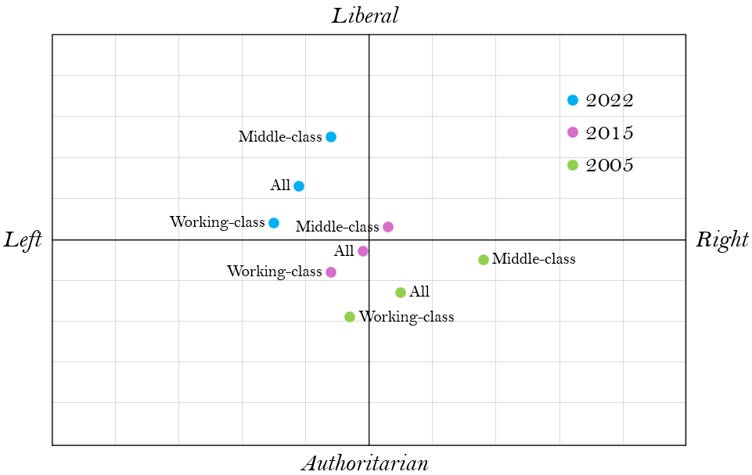
A host of factors have caused this: the housing market; increased regional inequality; rising migration levels; growing disparities in education as more people go to university; the shift away from an industrial economy, etc. But the consequences are clear. As the charts above and below show, for example, the gap between working-class and middle-class voters has become smaller on economic debates and larger on questions of culture and immigration in the past 20 years, according to the British Social Attitudes Survey (p.25). In essence, whilst society as a whole is getting more liberal, different groups are moving at very different speeds.
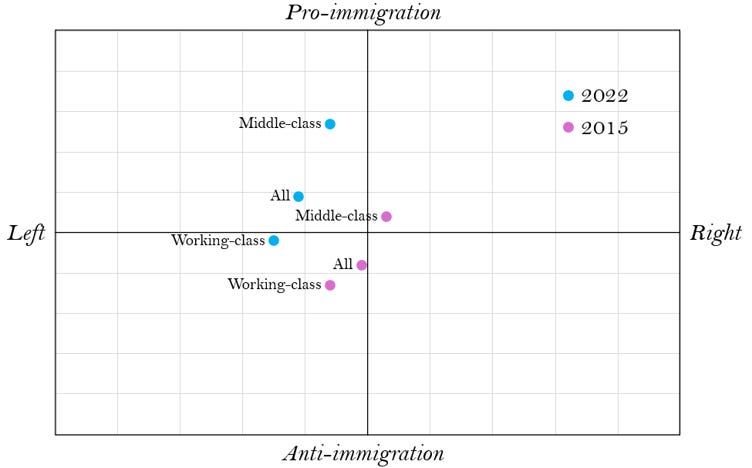
The key point to reiterate here is that the element of the political spectrum which is most divided – and which must be bridged – is no longer economic. Whereas New Labour succeeded through an economic settlement with broad appeal, contemporary centrists must find their equivalent compromise on immigration and culture. This is a different challenge.
The two blocs
The two changes to the centrist context described above have dovetailed, creating what political scientists refer to as the ‘two bloc’ model.
Voters are no longer loyal to a single party, but to a set of social positions – liberal or conservative. Five or six political entities compete for voters in the liberal bloc (Labour, the Greens, the Lib Dems, the SNP, Plaid and occasionally the Gaza independents). Two or perhaps three compete for voters in the non-liberal bloc (the Conservatives, Reform UK, and now Restore). Polarisation has replaced party tribalism.
There is some switching between the blocs, but not a lot. The key questions are how united and coordinated the respective blocs are, how determinedly they will vote against the rival bloc, and how determinedly the rival bloc will vote against them.
The Tories won in 2019 by uniting the non-liberal bloc against a liberal bloc which was inefficiently distributed and badly demoralised. (Reform’s decision to stand aside in many seats was instrumental here). Labour won in 2024 by uniting the liberal bloc against a non-liberal bloc which was divided and exhausted, and by detoxifying sufficiently that this non-liberal bloc did not rise up as one to defeat it (as they did with Corbyn). But in neither case could the winning party fully escape their post-Brexit trappings. The Tories won just 20% of Remain voters in the former election, and Labour won just 19% of Leave voters in the latter.[2]
An additional point here is about electoral geography. As Brexit highlighted, socially conservative voters are more efficiently distributed across the country. Leave voters made up 52% of the electorate in 2016, but 63% of seats were majority Leave. Hence winning these voters became more attractive after 2016, and the Tories bet the ranch on their ability to do so.
This dynamic has not gone away. When both blocs are ‘maxed out’ along lines of culture, the non-liberal bloc finds it easier to win. This was what happened in 2017 – a highly unusual election, in which deep antipathy towards the respective rival blocs caused both liberals and non-liberals to coalesce around the big two parties, often having to hold their noses in order to do so. It was a contest which the Tories of course won.
For progressive parties, this long-term structural question must eventually be overcome. The alternative is to be always at the mercy of the right bloc, should it choose to unite. But reversing the realignment has so far proven elusive, and there’s a danger that you throw bad money after good in seeking to do so.
Starmerism and the dead centre
This brings us finally to Keir Starmer. His premiership offers several cautionary tales about how not to navigate the new terrain. It also offers one key lesson about how you should do centrist politics, which I’ll come to later.
The first cautionary tale is that ‘talking right but governing left’ is a blind alley. This was a common tactic of New Labour, which often hid its progressive light under a bushel. But for Starmer the same approach simply made every progressive policy seem like less than the sum of its parts, scattering voters to other left-of-centre parties.
The more open attitude to the EU, the recognition of Palestine and the eventual lifting of the two-child benefit cap might all have meant more to liberal bloc voters had they seemed like things that Starmer was eager to do from the start. But Labour was deeply reluctant in each case. There is a similar story with the green growth and workers rights policies. Both were watered down, to public fanfare, and in each case the story became how much smaller they were than they might have been.
Doing progressive things in a way which appeared half-hearted opened Labour up to attacks from the right, which criticised the substance of the policies, without convincing the left that it shared their values.
The second learning since 2024 is about the New and the Blue. Both of these represent an idea of how Labour can adjust itself philosophically, to broaden its appeal. But they differ from each other to the point of being incompatible.
To put it in very simple terms, New Labour or Third Way approaches generally involve an embrace of internationalism and Europe, but also of free trade and open markets. Blue Labour does roughly the reverse, combining a rejection of immigration and Europe with a more collectivist or One Nation political economy. Each offers a concession to the right and an olive branch to the left.
I’m not claiming either have much to teach Labour now. But the problems which Starmer encountered came (as I suggested in the piece I wrote yesterday) through an apparent attempt to combine New and Blue. Pragmatism on markets, populism on migration. This made it very hard to keep the liberal bloc onboard.
The third learning, which is related to the second, is that finding a ‘middle position’ on immigration and culture is trickier than finding one on the economy. These are ‘identity’ issues for a reason: they cut to the core of who people are, in a way that topics like tax or public spending do not. There is less willingness to compromise.
On migration, in particular, the harsh language and policies in the early days left Starmer’s Labour marooned. The party’s role as a bulwark against Farage remains undermined by an ILR policy which is stricter even than what many Reform voters consider reasonable (p.35).
A particularly important point here is that liberal and non-liberal bloc voters appraise migration differently. The former listen to tone and language, seeking pushback against the tabloids and some acknowledgment of the value of diversity. The latter ignore rhetoric almost entirely. They judge based on results (or perceived results) on high profile issues like small boats and hotels. Hence, Keir Starmer’s ‘island of strangers’ speech caused anger with many liberals, yet did nothing to endear him to Reform voters. Labour’s framing should err towards the progressive, rather than seeking to project toughness, with the underlying policies designed to create an orderly and controlled system which works in the national interest.
A fourth learning from Starmerism is the risk of appearing to play the blocs off against each other. The idea that a policy is ‘annoying the right people’ is not a reason to pursue it. This was the approach of the Tories in their death throes – looking all the time for culture war issues which would provoke liberal outrage and unite the socially conservative bloc. And whilst Starmer’s Labour did not go too far down this path, there were flashes of it.[3]
Party management in particular strayed into this terrain. I personally supported high-profile efforts to detoxify at the start, including the expulsion of Corbyn. But there was overkill in terms of how far this was taken and how long it went on for.
A final cautionary tale from the Starmer ascendancy is the confusion about the 2024 inheritance. One of the ways in which New Labour was lucky, if that’s the right word, was that it followed on the heels of consecutive governments which were right-wing in tooth and claw.
Tony Blair’s centrism, in this context, was a marked shift leftwards – in that it prioritised public services and was socially liberal. Whilst left-wingers were disappointed it didn’t go further, New Labour were all the time doing things the Tories would not at the time have countenanced, like the minimum wage, SureStart and gay marriage. You could see the difference and make the choice.
The 2010-2024 Tory era, by contrast, was a political cockatrice: austerity, levelling up, Truss-o-nomics, the big society, Brexit, the furlough programme, hostile environment policies, net zero, the Rwanda scheme, etc. Labour failed to explain how it would be a clear departure. And Starmer and Reeves’ subsequent characterisations of the inheritance only added to this confusion – seeking to outflank the Conservatives to the right by claiming they’d ‘overspent’ and run an ‘open borders experiment’. The centrist style of politics which Starmer pursued thus had none of the clear points of differentiation which might have kept the liberal bloc onboard.
The ‘zone of sensibleness’
There is one area where we definitely can take positives from the Starmer years. This relates to a definition of ‘the centre ground’ not as a single point or winning post, but as an area of the spectrum which is mainstream and rational.
This area spans a large political range, from centre right outskirts to centre left fringes. I would call it a ‘zone of sensibleness’, and it refers to types of politics with the following traits:
Trustworthy on national security and defence
Competent on criminal justice and border control
Committed to basic fiscal responsibility
Willing to acknowledge the need for economic growth
Supportive of the rule of law
Willing to defend democratic norms and parliamentary democracy
Unsqueamish about patriotism
Averse to extremism, conspiracy theory and racism
Staying within this ‘zone of sensibleness’ doesn’t straightjacket idealism. The centre left can favour economic redistribution or Keynsian economics, whilst demonstrating basic budget discipline, or espouse rehabilitation in the justice system whilst being clear that crimes still need to be solved. Likewise, those on the centre right can favour cutting immigration, without breaking international law or tolerating overt racism in their ranks.
But staying inside this ‘zone of sensibleness’ is important in reassuring those who are not ideological diehards. Polling by Sam Freedman and Hold Sway, for instance, finds that the comparatively small group who continue to float between the two main blocs are those who “aren’t seeking to blow everything up or roll the dice”. They will balk at voting for politicians who persistently ignore the above guardrails.
Zack Polanski, Jeremy Corbyn, Rupert Lowe and Nigel Farage are all examples of individuals who operate outside the zone of sensibleness on certain points, albeit in completely different ways. Each of them alienates swathes of mainstream voters, through failing to offer basic reassurances and through engaging in antics which mark them out as headbangers. Each of them is divisive enough to cause the opposing bloc to set aside its differences and vote tactically to stop them.
Keir Starmer’s big success was in steering Labour back inside this ‘zone of sensibleness’ at speed, after the Corbyn era. This put Labour in a strong position when the Tories fell apart, and was a genuine political achievement given the timescales. Had Labour not visibly moved within the ‘zone of sensibleness’, the 2024 result could have been very different.
Conclusion
How can Andy Burnham’s Labour navigate the above terrain better than Keir Starmer did? How can he avoid the dead centre? There are four aspects to this.
The first is to remain in the liberal bloc, in a broad sense. Labour is a progressive party and voters lost to other left bloc parties are readier to return than those lost to the right. The leftish hue of those already coming back demonstrates this. Unless it wants to remain as friendless as it was in May 2026, Labour should not unnecessarily rile the liberal bloc. And there must be some clearer points of differentiation from the parties of the right, be it on legal migration or green growth.
The second aspect is to stay within the ‘zone of sensibleness’. Being in the liberal bloc does not mean ‘defunding the police’, shunning the Union Jack or prevaricating on NATO. Reassurance is important and, as the senior party within the liberal bloc, Labour must not flinch on national security or basic economic management. It must challenge other progressive parties when they’re unserious. Otherwise you end up with the Corbyn 2019 scenario: sensible liberals jump ship or stay at home, and the non-liberal bloc unites to stop you.
The third aspect is to find a migration settlement which pleases both blocs - and which works. Migration and culture are the new sources of division, and a ‘Third Way’ on this front is desperately needed. Migration in particular cannot be treated as a valence issue where everyone wants the same thing, nor as a compromise issue where you split the difference. I’d recommend the approach advocated by British Future, based on compassion, control, and international cooperation. This would make the process orderly and stop illegal crossings, whilst remaining a welcoming country.
The final element is to relentlessly foreground economic fairness. Persuasion UK argue that “while ‘culture war’ topics divide modern social democratic electoral coalitions, economic populism has the potential to unify it and split the radical right, especially when tied to ordinary cost of living concerns.” Their subsequent polling corroborates this. The more that left-of-centre policies on the economy and cost-of-living are at the forefront, and the more they’re discussed in terms of collectivism and fairness, the more Labour can win softer Reform voters. This is the best chance I can see of reversing the post-Brexit realignment and creating a coherent coalition.
[1] My observation here would be that most of the voters who are drawn to centrist platforms are either relatively apolitical swing-voters or are people who have a clear ideological ‘side’ but want to see it pursued in a more moderate way. Those who continue to carry the flame for New Labour, for instance, mostly do so because they’re on the centre left. They champion Blair and Brown’s progressive achievements and the pragmatism that made them possible.
[2] A particular error of Labour after July 2024 was to misunderstand its core support (focusing intently on hero voters at first, and then on progressive switchers after the Gorton and Denton by-election). Those who stuck with the party all the way through, often going back as far as 2005 or 2001, include those on low and middle incomes, and span ethnic minority communities in London, younger working-class residents and middle-class families. But they mostly tend to be liberal in a low-key way, invariably voting Remain in 2016 and generally putting less emphasis on immigration. They are closer to the ‘progressive switcher’ groups in values and outlook than they are to the ‘hero voter’ grouping tempted by the right.
[3] A spokesperson reportedly called, in the Gorton and Denton aftermath, for instance, for Labour to “sacrifice bourgeois support” and get tougher on migration, for instance. This was a highly provocative comment, in relation to England’s 15th most deprived electorate picking a Green MP.