

Notes on trust #1
Red herrings


Trust in politics is at rock bottom. This is a widely accepted fact. It is a phenomenon that has fuelled the many populist uprisings in Western countries over the past two decades. And yet the underlying reasons driving it have often not been given the level of consideration they deserve.
I became interested in this topic having done countless focus groups, in which otherwise fair-minded voters spoke of politicians with a venom which was at points overwhelming. I subsequently studied some of the literature and data on where this venom comes from. My abiding sense is that – whilst there was no golden age of political trust – the current trajectory is hugely alarming. It can neither be brushed off as a passing fad nor tolerated as a new operating context.
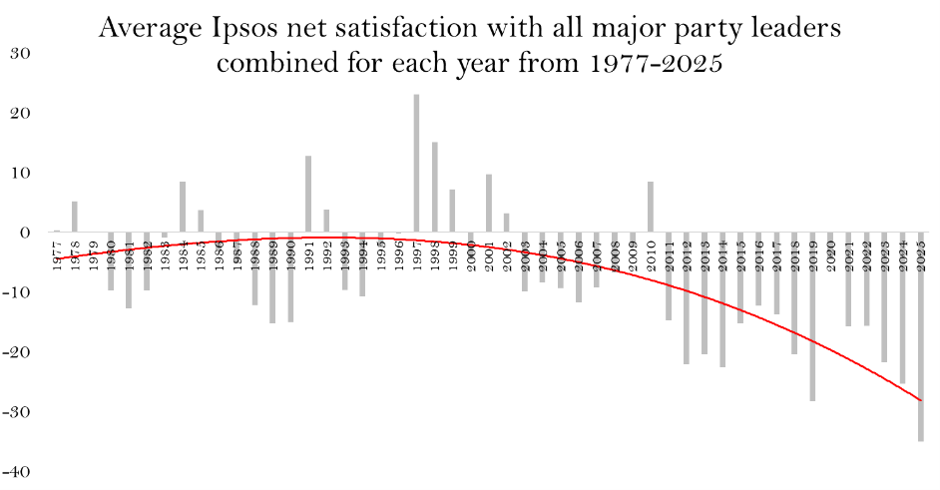
The chart below, for instance, is made using average Ipsos satisfaction scores for all party leaders since the 1970s. It shows a collapse in respect for senior politicians in the past two decades. As I wrote when I published it in an essay last year, the direction it points towards is unsustainable for a democracy. The ‘all the same’/ ‘none of the above’ impulse is becoming the default.
In future articles I’ll set out some thoughts on the core reasons for this – and on what can be done. But first I want to look at four ‘red herring’ explanations, often put forward to explain the collapse in trust.
Although I call these ‘red herrings’, I’m not denying that they exacerbate and inflame cynicism. But as catalysts for the anti-politics of the 21st century they’re heavily overstated. The nosedive in the chart above is not explained by any of them.
The FIRST red herring is the ‘will of the people’ being ignored. This blames the current contempt for politics on our leaders putting their own interests over popular ideologies and causes. (Or, conversely, putting their own ideologies and causes over the public interest). Getting past this seductive idea is an important first step for understanding trust.
The reading is most common with radicals and populists; among supporters of smaller parties or specific campaigns. It says that if only the government would full-throatedly pledge to repatriate migrants/ address the climate crisis/ tax the super-rich/ stop spying on us/ shrink the state/ leave ECHR/ stand up for Palestine/ protect the green belt etc, then they would be trusted again.
It’s true that for sections of the population these steps and others would increase trust. But for others they would reduce it (at least if pursued as stridently as supporters demand). Far from being deaf to the public, politicians are in fact listening intently. The problem is that on many of the more contentious issues they are hearing not a unified chorus they choose to ignore, but a noisy row between vocal sections of opinion.
By way of an example, the chart below shows trust in politicians during the Brexit period (courtesy of IPPR). Nigel Farage had described a ‘people’s army’ in the years before the referendum, whose anti-immigrant and Eurosceptic views had been shut out of the conversation by elites. No wonder trust was low, he suggested.
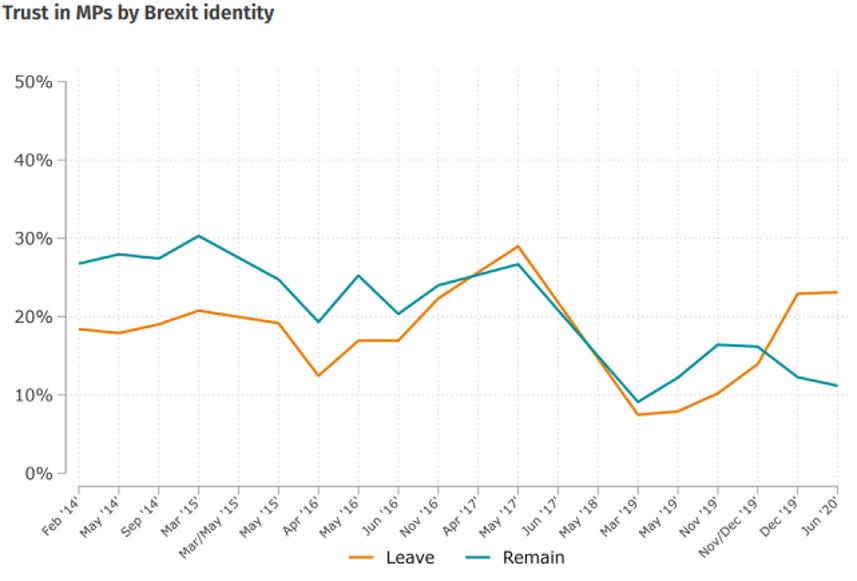
Farage was right, up to a point. Giving this people’s army what they demanded between 2016-19 did ultimately increase trust amongst its members. But it also caused trust to fall dramatically among opponents of the Brexit policy. There was a changing of the guard – with Leave voters trusting more and Remain voters less – but the net effect was not to allay cynicism. Quite the opposite in fact.
You can win the trust of all the people some of the time, or of some of the people all the time, to adapt the adage. But, contrary to the views of many partisans and ideologues, there is not a unified ‘will of the people’ which politicians choose not to deliver on.
The notion that there is has always been wrong, of course. But it’s especially flawed right now. Our society is the most varied it has ever been in terms of age, education level, wealth, faith, sexuality and ethnicity. Correspondingly, there is a broader range of values and viewpoints, meaning public opinion is less uniform than ever.
The SECOND red herring is failure to deliver. Leaders are distrusted because they’ve done a bad job across the dashboard of core metrics on which they’re judged, this says. Govern well and people will trust again.
This red herring is, to many centrists and supporters of mainstream parties, what the first red herring is to those at the fringes. It too subscribes to the idea that politicians are distrusted because they’ve not given voters things which it’s within their power to grant. But it focuses on ‘valence’ issues (i.e. bread-and-butter topics where there’s widespread agreement among voters about the desired outcome) rather than on left- or right-coded causes which animate supporters.
These ‘valence’ outcomes tend to include: low crime, low taxes, full employment, high growth, short NHS wait times, properly staffed schools and a clean public realm. Things that cut across ideology and which most people agree are good. Deliver on these fronts and anti-politics will wither, our second red herring proclaims.
The flaws in this idea are best articulated in the famous 2024 US essay, ‘The Death of Deliverism’. This gained popularity after the 2024 US election – which the Democrats of course lost, despite a decent record on jobs, the economy and the management of the COVID aftermath. ‘The Death of Deliverism’ questioned the assumption that government performance is noticed and credited to the ruling party.
A comparable example from this side of The Atlantic was the New Labour era. Good outcomes were achieved across the delivery metrics described above (the economy, the NHS, etc). Yet voters’ willingness to give credit was often limited. Labour strategists of the time describe now the “I was lucky” phenomenon. People had positive interactions with well-funded services, but concluded that their experiences were atypical.
In the long-term, then, there’s only a loose relationship between metrics like GDP or NHS wait times and public trust. And on certain measures – crime being the most obvious example – there’s almost no relationship at all. Satisfaction with outcomes may placate voters, but it does not necessarily engender deeper faith in our leaders.
To underscore this, it’s worth looking at the chart below – taken from an academic paper by Will Jennings et al in 2017. The solid line shows that discontentment with our politicians has risen steadily since the 1960s, only paying lip service to events. Distain for our leaders was the same during the three-day week and the Winter of Discontent than it was during the opulent noughties.
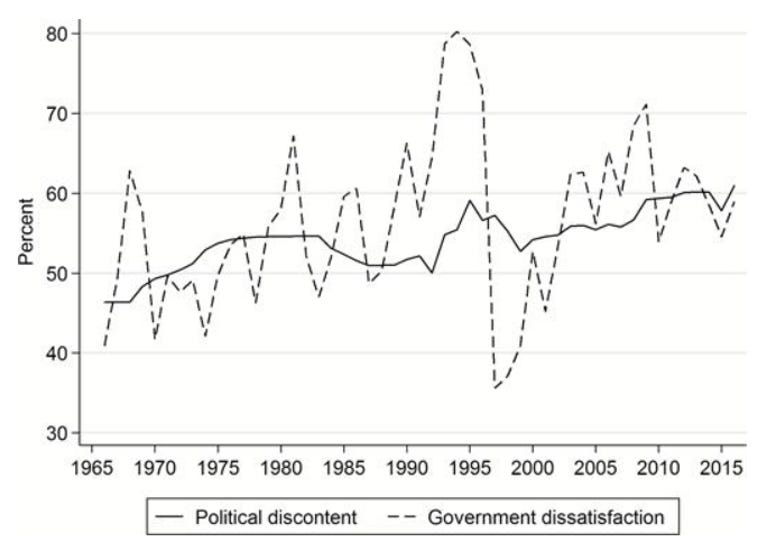
It goes without saying that economic growth and sustained improvements to public services will have a positive impact, all things being equal. But the above shows that delivery alone does not fully explain the political cynicism of the 21st century – and is not a panacea for tackling the present mood of anti-politics.
The THIRD red herring is an out-of-touch political class. Our leaders do not look and sound like us, this says. They know nothing of our struggles and have few brushes with real life. No wonder they can’t understand our problems.
This is the explanation for low trust commonly set out by voters. But it’s an analysis which politicians themselves latch onto for partisan reasons, to attack their opponents or present themselves as uniquely grounded. It actually comprises two distinct critiques – a lack of representativeness amongst parliamentarians and a lack of engagement with ‘real life’ outside the Westminster bubble. But in practice the two are usually rolled together.
A widespread popular folklore surrounds this characterisation. Our ‘male, pale and stale’ class of ‘toff’ politicians don’t know how the price of a loaf of bread. They enjoy subsidised bars and tearooms at the Palace of Westminster. They snooze in the chamber. They know each other from the same set of elite schools. They only visit their constituencies every four years to beg for our votes. Etc.
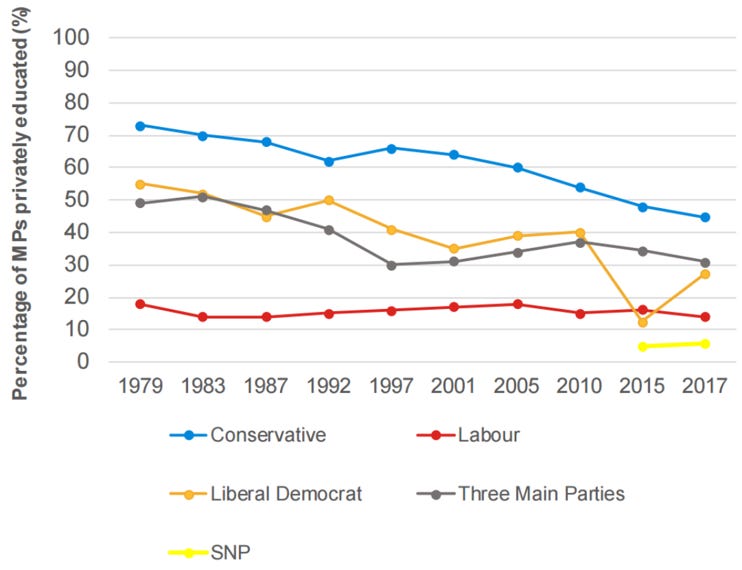
There are doubtless some MPs who come from these backgrounds or behave in these ways. But in my experience there are less of them than exist in the public imagination. And, more importantly from the perspective of this article, the number has got steadily fewer over time.
The chart below, for instance, shows the proportion of MPs who went to private school falling steadily from the 1970s onwards, courtesy of Full Fact. Indeed, the UK Cabinet is fully state-educated, at the time of writing.
Representativeness in terms of race, faith and gender has moved in the same direction. And whilst politicians still don’t fully represent the cross-section of society – with specific groups over-represented (those who’ve worked in politics, graduates etc) – the direction of travel is clearly the right one.
On the latter part of this charge, meanwhile – the absentee politician in their ivory tower – the trajectory is similar. MPs became significantly more rooted during the 2010s, for instance, when it comes to their having prior ties to the local constituency. The politician ‘parachuted in’ is rarer.
Likewise, over the period since the 1960s, the expectation that MPs live in the constituency and spend time there became far more pronounced. Regular local surgeries are the norm, and the caseload has increased exponentially. All of these things are comparatively new, and mean that the average politician understands the reality of the local housing office or GP waiting room better than they once did – and better than large swathes of the general public.
The situation is not perfect, of course. Some of our political representatives really do inhabit another world. But they are becoming less common, however you look at it. The present crisis of trust has in fact occurred at a point where Britain has an unprecedentedly ‘in-touch’ political class.
One thing to point out here is that the many antiquated customs that exist in the Houses of Parliament work to mask positive changes. Voters see politicians going through obscure rituals and conclude, understandably, that they live in more of a bubble than they do. For instance, whilst the House of Lords has become more egalitarian during the past three decades, thanks to a range of reforms, the ermine and induction ceremonies persist. But even on this point, we must remember that trust was higher during the decades when the second chamber was even more antiquated.
Moreover, it’s worth noting that the politicians our cynical public seem to be drawn towards to ‘restore trust’ are often public schoolboys who’ve spent their lives in the bubble. Jeremy Corbyn, Boris Johnson and Nigel Farage have all managed to ride the mood of anti-politics in different ways, despite minimal ‘man on the street’ credentials.
Farage, in particular, is an embodiment of the absenteeism and privilege voters claim to hate. Yet he’s trusted far more by sections of the electorate than rank-and-file MPs who are hard-working and conscientious. So there’s a serious question about whether the electorate are actually looking for leaders who are in touch, or whether they’re in search of something slightly different.
The FOURTH red herring is corruption and misconduct. Our leaders are mistrusted because they feather their own nests, siphon money to friends, rack up bogus expense claims or engage in other sleazy antics.
This ‘pigs at the trough’ characterisation is again a common voter explanation for mistrust. And, once again, it is used by partisans and those in opposition, who promise they’ll be ‘whiter than white’ or ‘drain the swamp’.
Whether this is a true red herring is a tricky question. Party-gate and the Peter Mandelson scandal are just two recent examples of all-too-genuine misconduct. Both delivered blows to public trust. The 2009 Expenses Scandal, meanwhile, remains a sea-change moment; the year when trust really started to curdle.
The key question, however, is not whether these scandals have damaged trust, but whether the types of misconduct they unearth are more common than they once were. Are our leaders sleazier than in the 1960s, 1970s or 1980s, when trust was higher?
If the answer is yes, then we can conclude that cracking down on corruption and sleaze is a big part of the answer. But if it’s no then something different is going on. It may be that the levels of misconduct are stable or falling; that we are hearing about scandals more regularly for the precise reason that there’s greater accountability.
The long-term UK pattern is hard to discern. There were headlines last year when it was revealed by Transparency International that the UK had become notably more corrupt in the years following COVID. However, the UK’s overall position has fluctuated dramatically since the index was created in 1995, rather than falling steadily.
In the absence of clear historical data going back further, international comparisons provide an interesting counter-factual. The chart below is created by cross-referencing the 2025 anti-corruption score given by Transparency International’s index against ‘trust in the government’ according to the Edelman Trust Barometer’s analysis of 28 countries during the same year.
Clustered in the bottom right corner are a group of developed nations with low government trust according to the vertical axis, but with low corruption according to the horizontal one. The UK is amongst these, along with the likes of France, Japan and Germany.
These low trust, low corruption countries have their counterpoint in the top left of the chart, where a series of high trust, high corruption economies are clustered, such as China and Indonesia. There is also a set of countries with high corruption but lower trust, especially in South America and Africa.
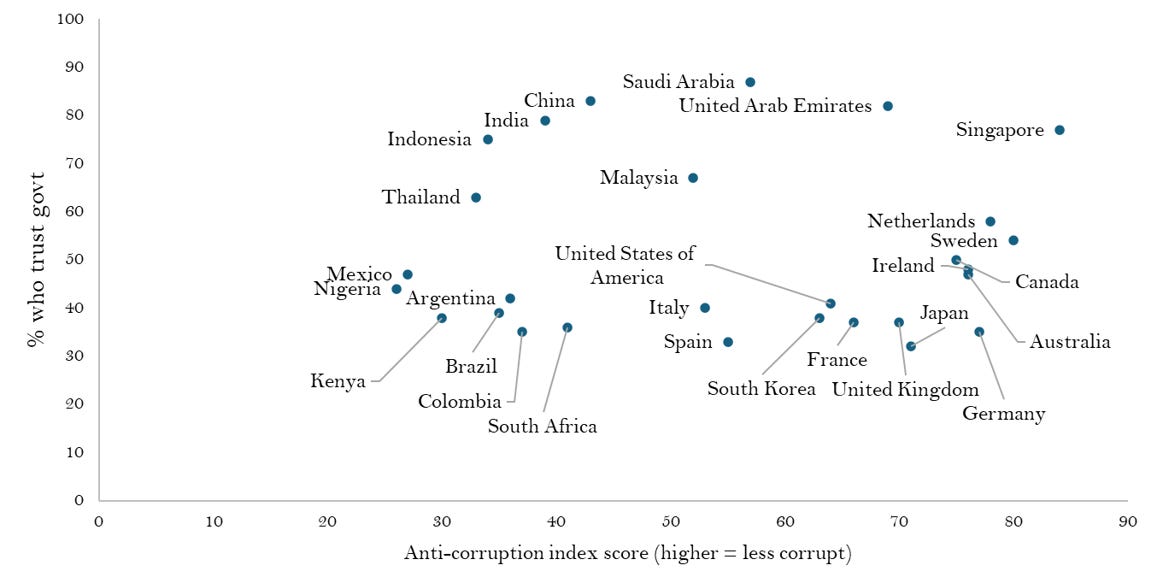
Doubtless there are many nation-specific factors. But the above exercise gives lie to the idea that low corruption translates automatically into high trust. The UK has amongst the lowest levels of corruption in the world (ranked 20th least corrupt of 181 countries overall, even after the Boris Johnson premiership). Yet cynicism about our leaders is higher than in nations where it’s endemic.
Returning to the UK’s trajectory, which is the all-important factor, my general impression would be that many more mechanisms exist to prevent and expose misconduct – certainly compared to 50 years ago. But increased inequality and the rise of big business mean that more money is flowing around politics. Sectors like lobbying have expanded hugely.
The extent to which these things cancel each other out requires a wider discussion. And my personal view is that reform of party funding would make a big difference, as would regulation of lobbying.
But the key factor which has really changed since the start of the 21st century is not the behaviour of our leaders but the information environment and the level of exposure. This means that a story like party-gate or the freebie episode emerges more easily, more often and in far more detail. Whilst reducing corruption further can make a difference, the heightened scrutiny which means it is now invariably brought to light is the element which is genuinely new.
To reiterate, I call these four explanations red herrings because they don’t, in themselves, explain the country’s slide into political cynicism during the 21st century.
Each of the red herrings of course provides, in their own way, a plausible and often genuine set of explanations for low trust, reached for by voters, commentators and politicians alike. Our leaders have become maligned because they’ve ignored the ideological clamour for X, Y or Z; because they’ve done a bad job of running the country; because they live in an ivory tower; because they’re too busy lining their own pockets; etc.
But the failures that each red herring points towards, whilst sometimes real, are not new. Politicians a few decades ago were guilty of the same failures – often to a greater extent – without being as despised as they are today. Hence, there is nothing to say that tackling the four red herrings will restore public trust to the extent we imagine. The root causes are both a deeper and subtler than the current go-to answers suggest.
I’ll look in the next article at some of the root causes which do explain why trust has fallen. And I will then look in follow-up pieces about the practical steps politicians can take.