

Notes on trust #2
Root causes


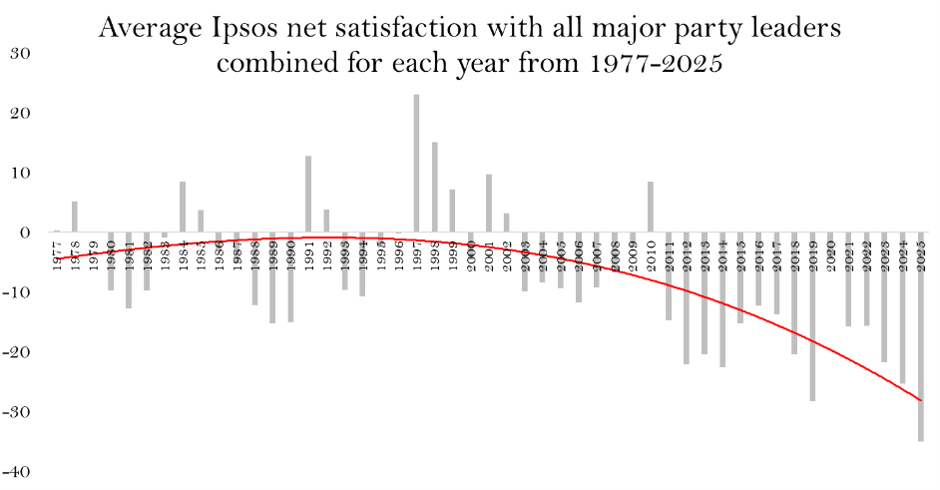
I wrote previously about four ‘red herring’ explanations for the collapse of political trust during the 21st century (exemplified by the chart below). My core argument was that trust has not declined for the reasons we often think it has: refusal to listen to the ‘will of the people’; failure to deliver; out-of-touch leaders; or political corruption.
Whilst these phenomena all exist and all undermine faith in our leaders, none of them are new, or became especially more pronounced in the period during which trust really tanked. We need to look at aspects of the wider context MPs and leaders are operating in, to understand the new anti-politics.
Below are four root causes which have, I believe, created a context where political discontentment is more likely. All four are things which are mostly welcome (with some exceptions). But they’ve each dramatically altered the trust climate.
The FIRST root cause is the decline of social deference. This describes a set of positive social changes, in terms of the public’s willingness to challenge its leaders. People have become less willing to submit to a higher authority; less willing to ‘know their place’; more willing to pride themselves on their discernment or to ask ‘how’ a decision-maker will do something, etc.
For instance, in a study a few years ago, ‘Class, Politics, and the Decline of Deference in England, 1968–2000’, academics described how growing socio-economic stratification in the 1980s had happened in line with the curious demise of class deference. People became less willing to submit to their ‘betters’, even as society itself became more unequal.
Factors driving the decline in deference would likely include rising education levels, growing prosperity and home ownership, and a range of positive cultural shifts, which foreground equality, the validity of lived experience and respect for the individual. These changes are natural and organic, I would argue, and are products of a more developed and informed society. But they mean scepticism is the norm and expectations of leaders are higher.
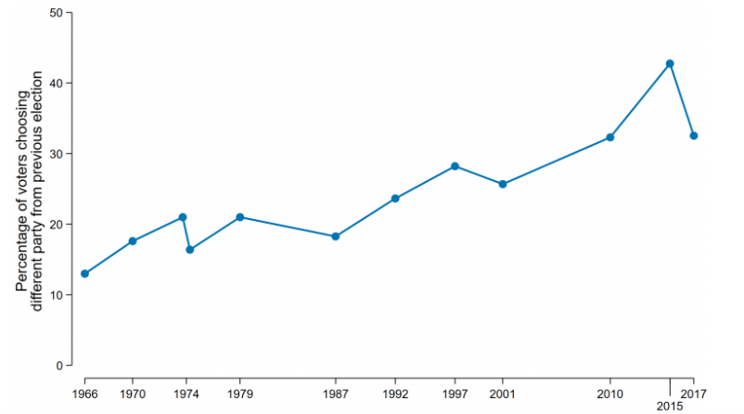
The decline of political tribalism is a corollary of this. The chart above, taken from the British Election Study series, shows a three-fold increase since the 1960s in the proportion switching their affiliation at each election. Voters no longer defer to political parties, any more than they defer to governments, experts or other decision-makers.
The fall of the deferential society is without question a net positive (as is the decline of political tribalism, I would argue). But a more individualistic electorate means that trust is no longer a given in any quarter. Leaders must engage with voters in completely different ways – and on a much broader range of topics – in order to earn their respect.
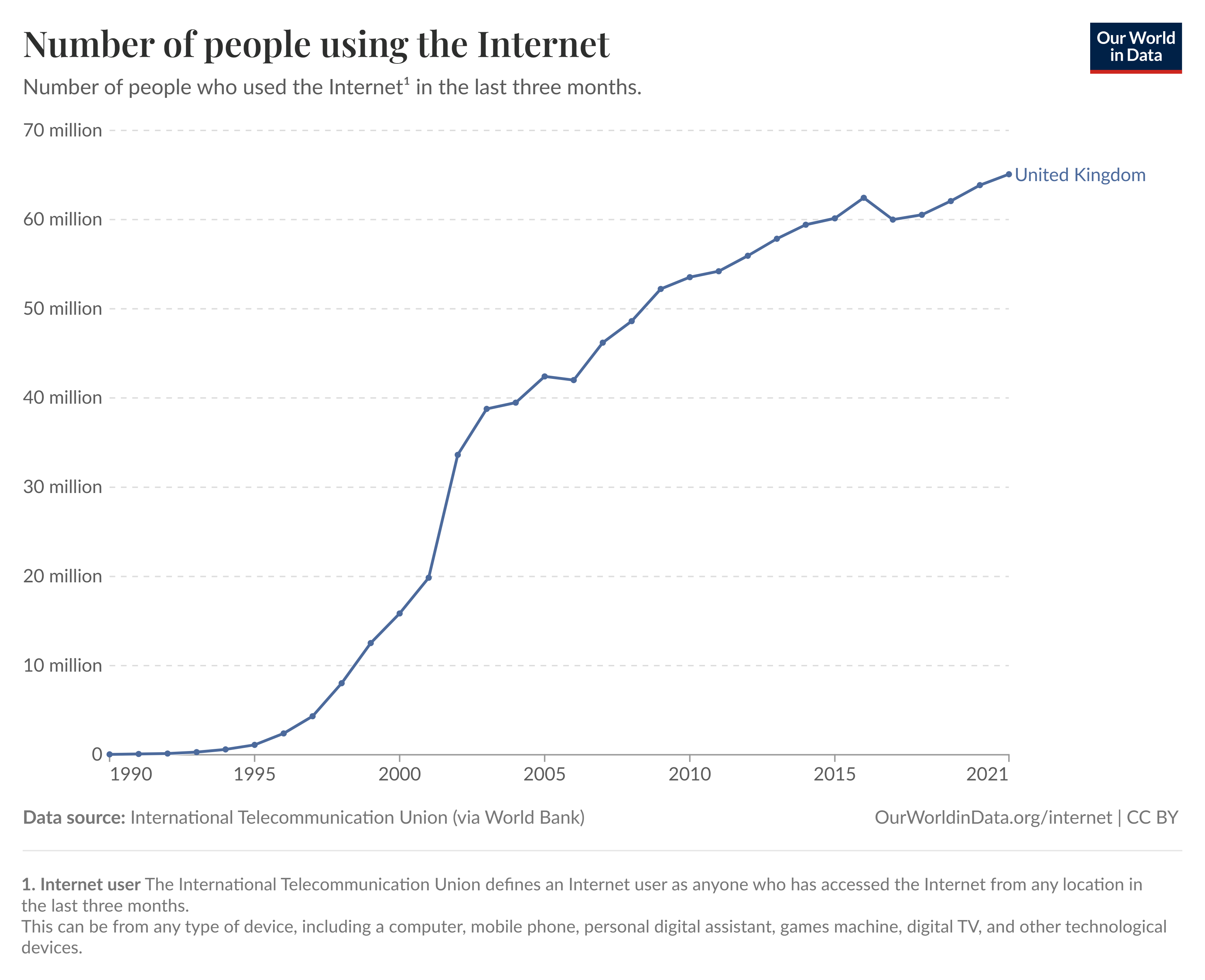
The SECOND root cause is increased exposure, information and scrutiny. This is mainly a media and social media phenomenon, linked to new technology. The chart below, taken from Our World in Data, shows the extent to which the internet became ubiquitous in the UK, from the mid-2000s onwards. There is a vastly greater amount of coverage now available. And more political and social failings end up in the public domain as a result.
This shift is reinforced by a range of newer – or more widely used – measures to hold decision-makers to account, such as FOI requests and Judicial Reviews. These again play out in the media environment.
The changes I’m describing will, of course, be familiar to most readers. Between 1990 and the present day we went from five TV channels to a 24-hour news culture. The camera-phone meant both that every gaffe was exposed and that genuine examples of appalling conduct came to light. The internet created ways for voting records to be interrogated and for expense claims and private WhatsApp exchanges to be pored over. Social media meant a new citizen journalism and an environment of constant commentary.
The level of scrutiny that exists in the age of the internet and the smartphone is completely new, therefore, and has undermined trust by systematically exposing failure. This exposure can take the form of a select committee grilling of Morgan McSweeney being live-streamed and televised, of an interactive data-blog showing misuse of public funds being published, or of a party activist being captured by a Ring doorbell saying something offensive.
The phenomenon correlates exactly with the period during which trust started to really fall. And it links directly to the decline of deference described above, giving populations who were already becoming more sceptical a daily reminder that their leaders have feet of clay.
Below are several specific aspects and phenomenon which relate to the above, each of which are worth pulling out in isolation:
· The decline of universally trusted information sources. Martin Gurri’s excellent book, The Revolt of The Public, sets out an argument that, beginning in 2000, the monopoly held over information by a few trusted sources began to weaken. This sounds like a good thing, and was initially taken as such. But Gurri argues that it was double-edged sword – often rewarding attention-seekers and conspiracy theorists, or offering angry sections of opinion an alternative truth.
· The atomised society. The technological age, particularly in the era of COVID and the cost-of-living crisis, has unmoored people from communal experiences, face-to-face interactions and shared debates. This links to the rise of exposure and scrutiny indirectly, because it means people go online and curate their own information environment.
· Steady accumulation of the negative. The information age means negative events are documented more fully. The more high-profile and frequent this documentation, the more it reinforces perceptions. Post-war scandals like the 1960s Profumo Affair might have been taken, by the average citizen at the time, as isolated incidents. But as these episodes began to be caught more often and exposed in more detail, it created the sense that misconduct is everywhere.
These arguments may sound staid, harking back to arguments about ‘post-truth’ politics in the late 2010s. But the news environment which the internet and the smartphone has facilitated does, I believe, create a climate where trust is harder to win and easier to lose.
The THIRD root cause is the heterogeneous society. There is far greater variation within the UK population, when it comes to life experiences and backgrounds, than there was in the past. The same is true in most developed countries.
The age range is greater, for instance, thanks to our aging society. Diversity levels are higher in terms of ethnicity and faith, thanks to migration. The spectrum is broader when it comes to education levels, thanks to larger proportions going to university (tending to mean a more complex mix in terms of social values). Economic experiences are more varied, thanks to post-industrialisation increasing regional inequality. LGBT communities are significantly larger. Etc etc etc.
The class system, in particular, once the main tribal faultline, has become much more complex. When a team of academics led by Mike Savage in the 2010s set out to create a new class structure fit for the 21st century, for example, they identified no less than seven distinct groups – including ‘Emergent Service Workers’ and ‘the Precariat’.
These changes mean that consensus around political issues is harder to establish, with the space at the middle of the Venn diagram having shrunk. On a topic like the housing market or even immigration, lived experiences in London are dramatically different to those in the North East, in ways which would have been nothing like so pronounced sixty years ago. Political views vary accordingly.
On identity and social issues, meanwhile, a much larger number of issues exist with the power to divide opinion. Trans rights or the politics of the Middle East would have personally affected or motivated far fewer citizens in the 1970s or 1980s.
A mixed society is in my view a stronger one (inequality notwithstanding). But the net effect for politics has been a breadth of perspectives and issues, which makes it extremely difficult to build voter coalitions. It’s no coincidence that the most successful politicians of the 21st century have tended to be demagogues, who divide popular opinion but enthuse small or geographically concentrated groups.
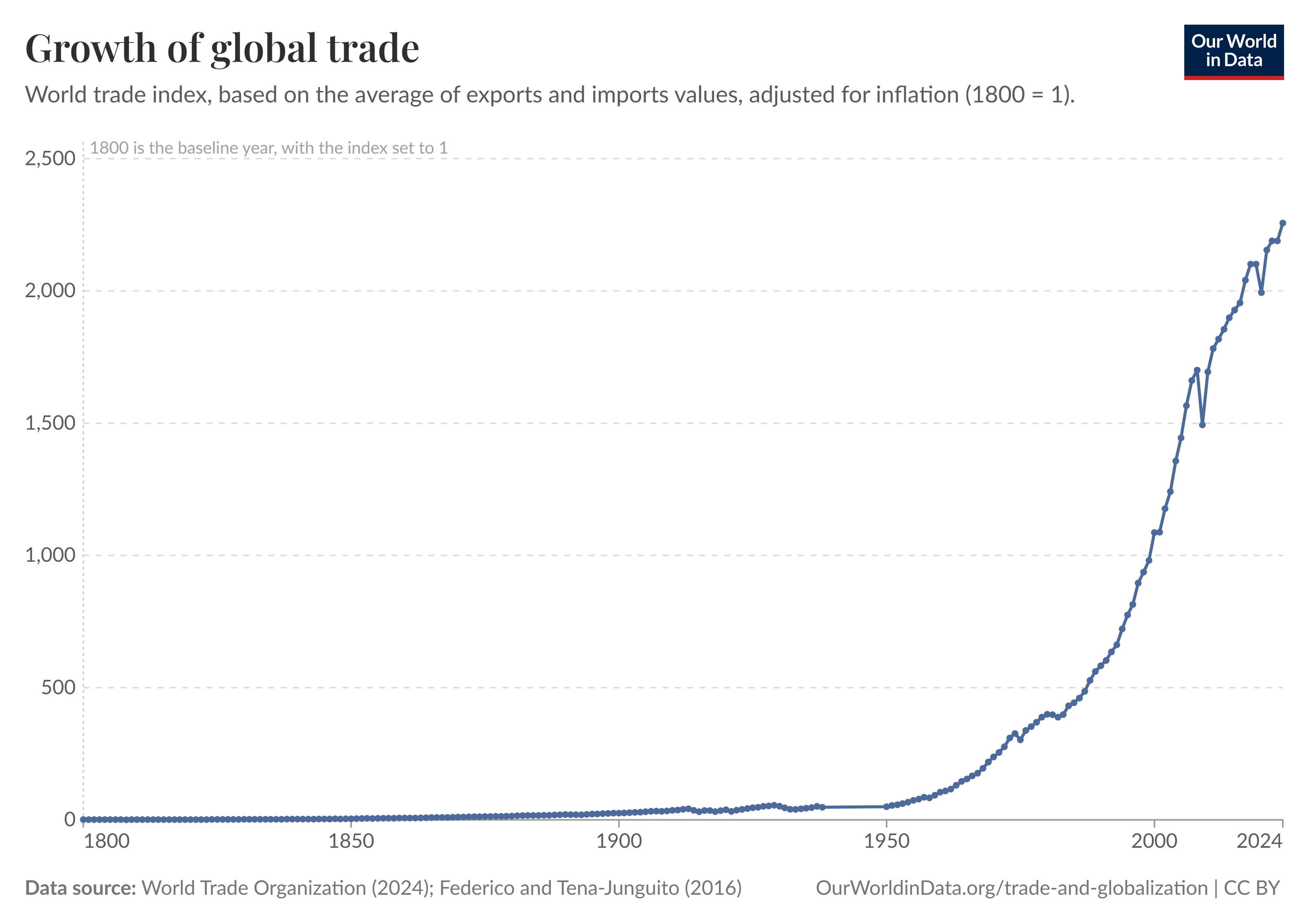
The FOURTH root cause is the impact of globalisation on governments’ agency. The interconnectedness of countries since the start of the 21st century – illustrated in trade terms in the chart below – has reduced the ability of national politicians to enact the policies voters want (at least without inflicting major damage in the process).
Two particular voter demands have been made more challenging. The first is immigration, the primary concern of the right. Interconnectedness has made cutting immigration to the degree that some demand almost impossible. Setting aside whether doing so is desirable or right, it is difficult in practical terms without inflicting self-harm. The last Tory government is a good example. Sunak and co maintained high levels after Brexit, despite publicly pitching themselves as ‘tough’ on migration.
On asylum, meanwhile, which is frequently the true bone of contention, absconding from international agreements carries massive diplomatic side-effects. Indeed, the post-Brexit period has demonstrated that ‘unshackling’ yourself from global institutions actually reduces border control, all the while losing you respect and influence.
The left-wing equivalent example, meanwhile, is inequality – and the corresponding ability to regulate big businesses or tax the super-rich. The reliance on international trade and markets to deliver growth means that almost every developed nation has reduced corporation tax since the 1990s, and has sought to appear pro-business at some level.
Redistributive policies – such as the Green Party’s proposed 10:1 pay ratio within every organisation – are hard to achieve as a result, and generally bring unforeseen side effects, if pursued unilaterally. (The predicted impact on the Premier League being a case in point). Hence governing parties on the centre left often shrink from such ideas, once they’re faced with the reality.
In essence, sections of the population are asking our leaders for things which cannot be done without self-harm to the economy, for reasons which are extremely technical and complex to explain. Steps that the right or the left see as basic common sense – such as sending boats back or banning eight figure salaries, respectively – require almost significant extrication from the international system to be achieved. This is not to say we could not do more on wealth inequality. But it’s to say that room for manoeuvre has narrowed, forcing the main parties closer together.
To deal with the four shifts described, the traditional parties have professionalised, moderated and generally become more risk averse – creating a type of politics which infuriates many voters and further undermines trust.
Message discipline has become the norm, for instance, to manage an environment where errors can be magnified at an unprecedented scale. Electoral triangulation has been practised, to try and capture groups of swing voters who no longer defer to tribal allegiances. Valence issues have become the safety zone – to avoid straying into divisive questions which may split a heterodox electorate. Growth has become the policy lodestar, to fund services.
This situation has fuelled populist and oppositionist movements, who present themselves as insurgents against an identikit centre. And this in turn has led some mainstream parties – such as the Tories under Johnson and Truss – to mimic these populist behaviours. These political responses have, in the UK at any rate, brought diminishing returns, creating disappointment and accelerating the collapse of trust.
The four root causes I focus on above are largely irreversible. We could not get the toothpaste back into the tube when it comes to the internet or globalisation, even if we wanted to. Hence, modern politicians who are serious about rebuilding trust need to think about a whole new way of conducting themselves, which is fit for the 21st century. Future articles will look at some ways of doing this.