

Notes on trust #3
Exposure (and Moynihan’s Law)

I recently wrote two pieces on trust. The first included the argument that falling trust is not down to rising misconduct and failure, but to a climate where misconduct and failure is more likely to be unearthed. The second built on this, suggesting that the collapse in trust is heavily influenced by the intense exposure of the information age.
This third instalment looks at this in more depth, using some international comparisons. In particular, it explores the idea of Moynihan’s Law, in relation to trust. Attributed to the Democratic Senator Pat Moynihan, this maxim states that:
The amount of violations of human rights in a country is always an inverse function of the amount of complaints about human rights violations heard from there. The greater the number of complaints being aired, the better protected are human rights in that country.
Moynihan’s Law can be applied to fields beyond human rights. For instance, in parts of the world where health outcomes are better, studies often find that self-reported health is worse or that self-referrals to doctors are higher – as people become more health-conscious. Elsewhere, Steven Pinker had described the ‘violence paradox’: the less violent a society gets, the more concerned its members become about violence.
Disproportionate public discontent is, in these instances, the price paid for higher standards and a greater vigilance. Do the same principles apply to democratic trust?
The chart below offers one way to answer this question. It is created by comparing the data for trust in the government according to the 2026 Edelman Trust Barometer (vertical axis) with the score attributed to each country by the 2026 Press Freedom Index (horizontal axis). It points towards a paradox which I believe has echoes of Moynihan’s Law: political trust is high in places with low press freedom scores, and is low in places with high press freedom scores.
This inverse correlation is not completely set in stone; some countries with high press freedom do better than others for trust. But the pattern is nevertheless stark. It applies to developed countries that are both to the left and to the right of the UK, politically. It applies to those which are better run and worse run than we are, and to those which are more and less corrupt.
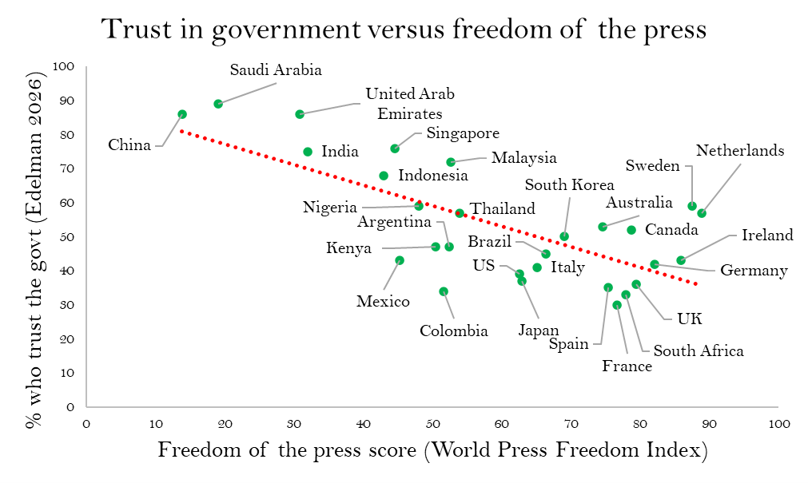
The trend described runs counter to the rosy idea that high accountability goes hand-in-hand with high trust. And at one level it may seem baffling. Why would people have greater faith in governments who censor opposition or shut down the fourth estate?
At another level, however, the pattern we can see makes perfect sense. In places where failings invariably end up in the public domain, trust in our leaders is liable to fall. The more alive we are to these political failings as a society – the more we know about them and the more likely they are to come to light – the more convinced we will become that we’re ruled in ways that are undemocratic, incompetent or corrupt. This is Moynihan’s Law in action.
It could, of course, be argued that this isn’t inevitable. If we were to eliminate failure and misconduct completely from our politics, there’d be nothing to expose. No sleaze, no lazy policy-making, no ineptitude, no absenteeism. However, this strikes me as unrealistic. If we want the country to be governed by people who are in some sense ordinary, we must accept that failures will sometimes happen – both in terms of professional competence and personal conduct.
Viewed through the lens of Moynihan’s Law, then, the 21st century’s high political cynicism could be seen as proof that our leaders are more trustworthy. Or, at least, that untrustworthy behaviour is more likely to surface and be punished. High distrust indicates an independent fourth estate and the robust scrutiny that comes with it.
I believe the overall implication of Moynihan’s Law is more complex than this, however, in relation to political trust. The chart above may suggest that a mood of perpetual anti-politics is the price we pay for a more open democracy – and for the steady exposure of public wrongdoing. Yet unlike with human rights, healthcare or violence – where excessive vigilance comes with few obvious downsides – it is now abundantly clear that low democratic trust has negative consequences of its own.
Indeed, the lesson of the past few years is that once trust for our leaders moves below a certain level – from scepticism to cynicism, from cross-examination to contempt – it starts to corrode the open democracy which created it. Changing things becomes harder, as people assume prospective candidates are lying. The state shrinks, as people stop trusting politicians to spend their money. Instability and governmental churn becomes the norm, as dissatisfaction kicks in more quickly. The need to manage the media means that the tail starts to wag the dog, when it comes to policy. Sensible people choose to avoid running for office, because the intrusion and public loathing makes it miserable. Etc.
The beneficiaries of low trust, in short, are those who are thick-skinned to a fault; those who are the least democratic in their instincts, who place the least value on an open society, and who are readiest to apply double-standards.
And this will surely only become more exaggerated, the greater the scrutiny becomes. If high exposure reduces democratic trust then the implication, by extension, is that absolute exposure will reduce faith in our leaders absolutely. The 24-hour press and the social media age could grind trust down to nil unless politicians learn to respond in better ways.
The key question that follows is whether a new manner of doing politics exists, which is capable of fostering trust in a climate of relentless challenge and coverage. The answers lie, I would argue, in a greater willingness among politicians to show workings and join the dots; in a desire to persuade rather than just adopt positions; in a refusal to pretend perfect outcomes are possible; in a rejection of excessive partisanship; and in a willingness to demand that voters engage with tough choices.
Yet the Catch 22 is that, within the present high scrutiny environment, these simple steps are heavily disincentivised. They involve massive risk for little or no gain. Thus, the path of least resistance for a 21st century politician is to keep your cards close to your chest and avoid the unnecessary exposure which these things would involve.
Finding a way to end this vicious circle ought to be, for those concerned about low political trust, the holy grail. In the next couple of articles I’ll start to explore some of the principles for doing this.