

Notes on trust #4
Airline pilots

Recently, I have written about the reasons for the 21st century decline in political trust. In particular, I wrote about some of the ‘red herring’ explanations that exist, arguing that neither failure to deliver nor deafness to the ‘will of the people’ can fully explain the collapse.
In this penultimate post, I’m going to look at these issues further, using the cartoon in the New Yorker shown below as a jump-off point. Published in 2017, a year after Trump’s first election victory, the sketch made fun of mindless populism. Within it, a group of airline passengers storm the cockpit, convinced they can do a better job.
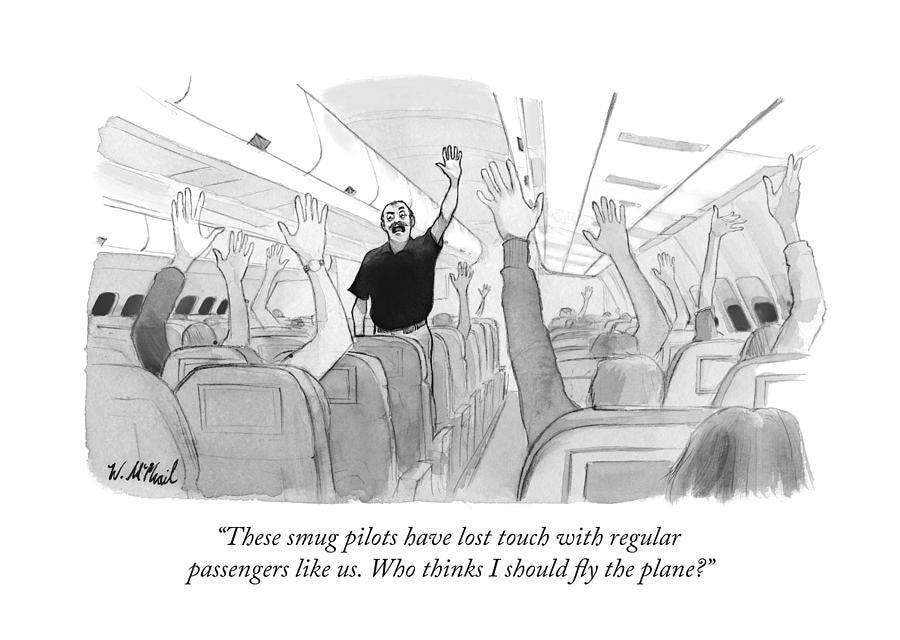
The premise of the cartoon attracted criticism – from the left as well as the right. Had politicians simply ‘flown the plane better’ they wouldn’t be subject to half as much hostility, many argued. One wrote that:
[The cartoon] assumes that the existing pilots have been doing a decent job. But what if they kept periodically crashing, and declined to repair the damage before taking off again? What if, due to operator negligence, the people in the cheaper seats were forced to hold on for dear life because some of their windows were shattered? … This rendering is much closer to reality. And it points to why many passengers might be eager for a change.
Both the cartoonist and his critics were being tongue-in-cheek, of course. But both embraced the idea that politics is, in some sense, comparable to flying a plane. The main point of difference was on the question of how well or badly it was being done in the first place.
This mirrors how many voters see politics; a hard job, maybe, but one which, done proficiently, should achieve outcomes which everyone is happy with. Politicians themselves collude in this, promising to ‘get the job done’ or to ‘clean up the mess’ left by their predecessors.
It’s perhaps no surprise, having been framed in this way so consistently, that a trust contest between pilots and politicians is a no brainier for most people. Airline pilots almost never crash or fly to the wrong destination, after all, whilst governments and politicians screw up at every turn. Correspondingly, 87% of us trust the former whereas just 9% trust the latter.
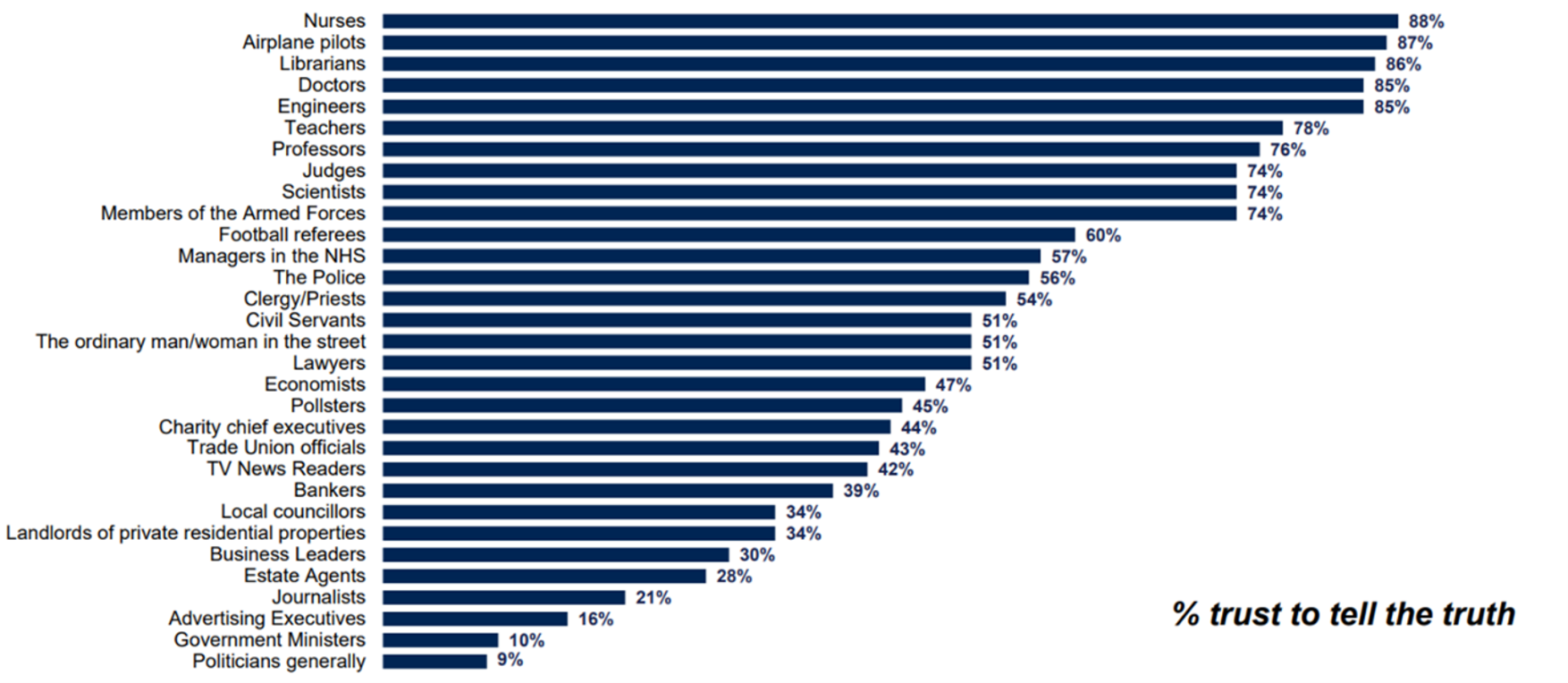
How is being a pilot different from being a politician, then? To understand why MPs and government ministers invariably prop up these types of lists, it’s worth giving serious consideration to this question.
There are two aspects to pick apart here. Both are, at one level, glaringly obvious. But they’re almost never acknowledged, and I believe they help us to understand two of the key skills which politicians need to rediscover in order to build trust.
The FIRST point of difference is about desired destination.
In almost all of the industries in the chart above – especially those which do best for trust – the goal is clear and uncontentious. The role of an engineer is to build a bridge which does not fall down. The role of a doctor is to accurately diagnose and to treat. Amongst some of the professions there is disagreement about how you achieve results – and sometimes there’s a political dimension to this. And there are a few professions which some people object to in principle. (A pacifist may always distrust a soldier, an atheist may always distrust a clergyman, etc).
But in most instances, there’s a strong sense of ‘what good looks like’. In the case of our airline pilot, everyone on the flight wants to go to the same place, and to do so safely, quickly and comfortably.
Politicians are almost the only profession on the list for whom this is not the case. Their first job is to set out a destination to get to. This destination will inevitably disappoint some of those taking their seats, and there will be a significant minority onboard any political ‘flight’ who really don’t want to go to the place the pilot is headed. It’s hard to identify a destination which enthuses enough passengers to get the plane off the ground, whilst winning the grudging consent of everyone else.
This has always been the case and is politics in its purest form. But, as I wrote in the second instalment of this series, one of the most significant changes in recent decades is that society has become both dramatically more heterogeneous and varied, and dramatically less deferential.
Rows of passengers now exist who have particular faiths, who have much higher or lower education levels than each other, who have strong interests in different foreign policy issues, who have wildly different experiences and perceptions of migration, etc. All of these passengers are better informed and more confident in speaking their minds than they once were. And many follow media platforms and channels which reinforce their views.
Finding a destination which this heterogeneous group can agree upon is therefore harder. And, in the face of this, politicians have tended to take two distinct approaches. The first approach is to choose a niche or highly ambitious destination, which enthuses around a quarter of the passengers, but has most of the rest up in arms. It might involve radical steps on immigration or major experiments on the economy.
Those who practice this often struggle to get into office. But they are trusted absolutely – adored, even – by those who support the proposed destination. Nigel Farage and Jeremy Corbyn are examples of this. Both have very high trust amongst their supporters – many of whom wonder why all politicians can’t be so authentic – but are toxic with large groups of other voters.
The second approach is to set out a destination which is modest and uncontentious enough that almost all of our hypothetical passengers, varied as they are, can agree upon it. This usually involves focusing on a set of ‘valence’ issues that all voters support – economic growth, a well-funded NHS, low crime etc – and not straying outside it.
This is generally considered the best strategy for winning, as it builds broad support, appeals to non-ideological swing voters and allows losers’ consent. But amongst the passengers on our heterodox flight, it will disappoint a large number, who wanted to go somewhere further away and more interesting.
Keir Starmer is an exemplar of this second approach, gaining a ‘loveless landslide’ in 2024 by playing it safe. The limitations of this are now being exposed, and unlike the Corbyn or Farage style pilot, Starmer does not have an enthusiastic base to fall back upon. Labour did, however, manage to win an election via the approach, and this cannot be overlooked.
What both models of pilot share, however, is that they do not make arguments in favour of a destination. Instead, they take positions, based on where different groups of passengers already want to go.
The former type of pilot – the Corbyn or Farage – takes one position stridently, animating the four of five rows of passengers who want to get to their chosen destination. Their USP is that they don’t budge on this, making little effort to persuade, reassure or explain their thinking, for the benefit of passengers who have reservations.
Indeed, moderating their position is risky for them. Choose a slightly less ambitious destination, and the cohort of passengers who backed you from the beginning may look elsewhere. (This is a challenge Nigel Farage currently faces, with Restore providing a full-fat option further to his right).
The latter type of pilot is incentivised in the opposite way: to take positions which ensure maximum consensus. They too avoid the sorts of concrete arguments – the efforts to inspire, the weighing up of honest pros and cons, etc – which might unite passengers behind a more ambitious destination.
If there’s a populist surge of some kind, for instance, the response for the second pilot type will be to try and ameliorate it with a shift in position – an extra control on migration, a new devolved power for Scotland, etc. But because the support base they are trying to hold together is broad, this cannot be done in a heartfelt way. It looks like a sop, and rarely works.
In conclusion, then, our ultra-varied electorate has led to two styles of leadership: one which undermines trust by animating the minority at the expense of the majority; and a second which undermines trust by appearing to have no set of fixed ideals. These two approaches, whilst in tension with one another since the dawn of politics, have increasingly become an either-or choice, the more strung-out society has become.
In a First Past The Post electoral system, the binary is especially stark, of course. Politicians who seek to blend the two frequently end up in a no-man’s-land – too little flexibility to build a broad consensus, too little conviction to engender loyalty.
The core skill missing, to reiterate, is the spirit of argument and persuasion, which might win around those who have reservations, without automatically compromising on position.
The SECOND point of difference is about competence versus delivery.
In almost all of the professions listed in the chart above, competence and delivery are close to one another. If an engineer is competent, the bridge will not fall down. If a pilot is competent, they’ll get all their passengers to the correct destination safely.
There are small gaps between competence and delivery – for instance, if a piece of equipment breaks or a storm hits. But generally speaking, an individual who is very competent will be able to deliver the best possible outcomes in these fields.
Going further down the list, the gap between competence and delivery grows a little. A business leader cannot guarantee perfect sales figures, for example. But for politicians, the gap between competence and delivery is largest of all. High technical competence does not guarantee delivery of perfect outcomes, nor even come close.
I always think here of the following quote by Douglas Jay, Clement Attlee’s economic adviser, in relation to the early days of the 1945 government:
My most vivid impression in all these months at No. 10 was the falsity of the illusion harboured by journalists, academics and others that something called ‘power’ resides in the hands of a Prime Minister. The picture drawn, or imagined, is of a great man, sitting down in his office, pulling great levers, issuing edicts, and shaping events. Nothing could be further from the truth in the real life of No. 10 as I knew it. So far from wielding great power, the PM at this time found himself hemmed in by relentless economic and physical forces, and faced with problems which had to be solved, but which could not be solved.
A range of factors have made this even truer in the decades since Jay was writing. As I wrote recently, for instance, globalisation has reduced contemporary leaders’ agency, especially on the economy and migration.
Yet the insistence of modern politicians is that competence and delivery are synonyms. A competent politician should be able to deliver the things we’re asking for. If they don’t then they must be incompetent. “In any other industry you’d be out of a job,” voters often complain.
Opposition parties, in particular, are guilty of playing to this this. The post-COVID, post-Ukraine war cost-of-living crisis, for instance, became the ‘Tory cost-of-living crisis’ in the mouths of Labour politicians, for much of the period running up to 2024. It was a problem which a competent government could quickly solve if it cared enough to do so, this implied.
Labour in office struggled to fix the issue, however, finding that they had less room for manoeuvre than they’d imagined. And this failure quickly came to be seen as a broken promise by voters. Both the Greens and Reform now attack Labour on this basis, even though they too would struggle to fix the problem.
How can the gap between competence and delivery be addressed, then, in a way that restores trust?
For one thing, the gap needs to be acknowledged by parties in opposition. In particular, the way in which policies are framed and campaigned upon exacerbates the problem. Parties lead with outcomes (‘immigration under 100,000’, ‘fastest growth in the G7’, etc). Yet they very rarely start with the ‘how’, or set out in honest terms the choices they will make to find the funding. Hence almost all discussion of policy comes to sound, to voters’ ears, like hollow promises. Hence, if they get in, they invariably disappoint.
But the real onus here is on governing parties. They could force the hand of opponents and expose easy answers, by showing their own workings. They could discuss in honest terms the dilemmas they are facing. They could show what’s under the bonnet or talk through the specific reasons why the small boats numbers increased as they did since 2019, or why the cost-of-living is so high.
Yet they invariably flinch at the weakness which this might signal, and instead rely on attack messaging. The adage remains that, to quote Ronald Reagan, ‘if you’re explaining you’re losing’.
Right now, for instance, the Labour government finds itself facing calls from the left to borrow more and not be ‘in hock’ to the bond markets. The tendency of some Labourites is to scoff at these ‘easy answers’ and the economic illiteracy they apparently reveal. Yet assuming they’re right about this, there’s an urgent need for a sincere, sustained explanation of the economic dilemmas the government is facing – which brings a lay-audience into The Treasury’s thinking.
As the Douglas Jay quote put it, the image of the leader ‘pulling great levers’ – as a pilot adjusts the controls in the cockpit – is a false one. Yet whilst the political class participates in this fiction, we can have only limited sympathy for the contempt in which they’re held.
To recap, the above sections point to two things which politicians should see as central tools for their trade.
The first is argument. Unlike a pilot, politicians must decide upon their own destination. With an extremely demanding and heterodox electorate, many in politics seem to have given up on the idea that you can persuade people. But by making serious arguments, rather than taking positions and landing messages, they will perhaps start to regain the respect of voters.
The second tool is explanation. At a time when challenges are so acute, politicians in government cannot guarantee perfect outcomes. Competency does not equal delivery, in the way that is does for a pilot. But by having the courage to explain the challenges they face, governments could start a more grown-up conversation with voters, rebuilding trust in the process.