

Notes on trust #5
The Blues and the Buffs

I’ve written over the past few days about some of the reasons for low trust in politics – often expressing sympathy with the challenges of modern governance. In this final instalment, however, I’m going to look at an area where they politicians do themselves few favours.
The Blues and the Buffs
A useful place to start is Chapter 13 of Charles Dickens’s first full novel, The Pickwick Papers. Written nearly 200 years ago, this passage of writing drives at the essence of political cynicism.
In it, the book’s protagonists arrive at the fictional town of Eatanswill. The entire place is dominated by a rivalry between two parties, the Blues and the Buffs, who seek to run the local institutions and who bitterly loathe each other. Dickens describes this as follows:
Every man in Eatanswill…felt himself bound to unite, heart and soul, with one of the two great parties that divided the town – the Blues and the Buffs. Now the Blues lost no opportunity of opposing the Buffs, and the Buffs lost no opportunity of opposing the Blues; and the consequence was, that whenever the Buffs and Blues met together at public meeting, town-hall, fair, or market, disputes and high words arose between them. …Everything in Eatanswill was made a party question. If the Buffs proposed to new skylight the market-place, the Blues got up public meetings, and denounced the proceeding; if the Blues proposed the erection of an additional pump in the High Street, the Buffs rose as one man and stood aghast at the enormity. There were Blue shops and Buff shops, Blue inns and Buff inns – there was a Blue aisle and a Buff aisle in the very church itself.
During the rest of the chapter, the Blues and the Buffs are satirised for this partisanship. They barter, bicker, and are astounded that those visiting the town aren’t as invested in the rivalry as they are.
Dickens’ dim view of politics was echoed elsewhere. In Bleak House, Lords ‘Coodle’ and ‘Doodle’ – two interchangeable politicians – spar over minute differences, blind to the vast challenges facing society.
As an English Literature student with an interest in politics, I always found Dickens curious in this regard. He combined a deep interest in social reform with a contempt for politics which verged on the juvenile. Yet I’ve come to think that, in this, he captured aspects of the popular zeitgeist which more politically serious writers missed.
Politics as a game
Charles Dickens’ send-up of ‘the Blues and the Buffs’ is strikingly similar to the complaints we hear today. During hundreds of hours of conversations with voters of all persuasions, one of the most consistent themes is their contempt for negative campaigning by politicians. It prompts not just frustration but revulsion.
The kernel of this disgust is the sense of ‘politics as a game’. Voters observe awful and urgent challenges piling up in their news feeds and their own lives. They then look across to a political class smearing and sniping at one another, often appearing to turn real world challenges to political advantage. They are appalled.
This impression of constant point-scoring drains faith that politics can be a force for good. It removes the sense of objectivity which is vital for politicians to be taken seriously. It implies that politicians think government is easy; that the country’s problems come down simply to a question of whether the ‘bad’ party or the ‘good’ one is in power. And it cries wolf, attacking the other side so unvaryingly that by the time a true monster arrives on the scene voters have stopped listening.
All of these negative consequences become more exaggerated the smaller the true disagreements seem to be. With the Blues and the Buffs, the source of Dickens’ satire was not just that the two factions were kicking lumps out of each other, but that they were doing so on the basis of minimal differences.
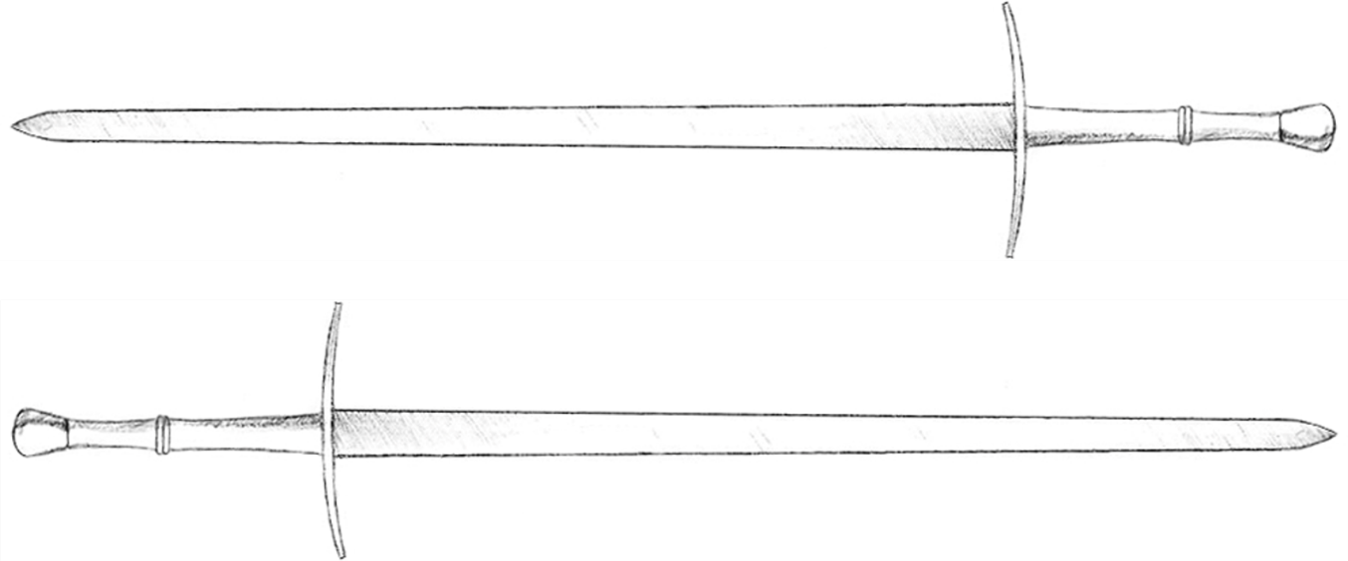
‘Two swords and one inch apart’
This ties into an interesting aspect of UK politics’ trust challenge. As we saw in the third instalment, we’re not alone among developed nations, in having low democratic trust. Yet by looking at the nature of this, we start to see something interesting. Specifically, Britain underperforms compared to OECD averages when it comes to trust in politicians, but overperforms (a little) when it comes to non-party-political functions of government. The chart below, based on OECD analysis, shows the disparity.
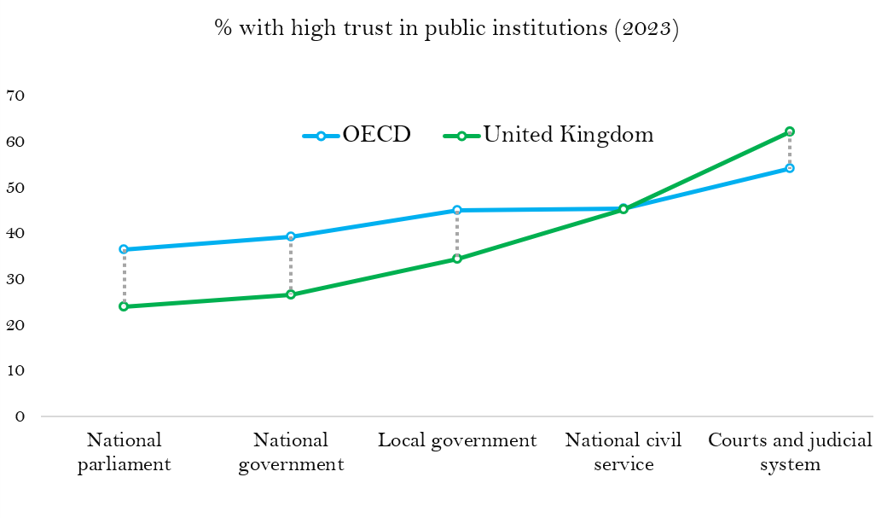
This finding is backed up in other polls. It implies to me that the UK’s political culture plays a disproportionately large role in dampening trust, compared to in other developed countries. And I’d venture that our more attritional style of politics is a big part of this – rooted in a First Past The Post (FPTP) voting system, and in a chamber set up so that two parties can do battle, ‘two swords and one inch apart’.
Prime Minister’s Questions (PMQs), which is the forum voters most frequently see televised, epitomises this abrasive culture. It comes up constantly in focus groups. Coupled with the impenetrable rituals in which the House of Commons is draped, the PMQs format steadily reinforces the public’s sense of ‘politics as a game’.
The voter ideal
What do voters imagine that politics should look like, if it’s not this type of fierce contest? Firstly, I think, they want the parties to stand for things which are distinct – a gap in the market which each seeks to fill. The party of fairness and public services; the party of business; the party of the environment; the party of traditional values, etc.
These parties should then debate the issues, in a way which is robust but respectful. This healthy dialectic improves the policies all parties arrive at.
Come election time, the parties should display their wares, talking us through the detail of how their policies will work, as a salesperson at a trade show might excitedly describe the features on a new product. They will tell you why theirs is the best on the market, for sure. They will hint that the alternatives don’t match up. But they won’t gratuitously bash their fellow vendors.
All the parties are expected to be proposing things which are doable, meanwhile – i.e. to be selling products which work. The numbers ought to have been totted up beforehand and the safety checks should have been made. If there are risks attached to a purchase these will be acknowledged.
Voters’ end of the bargain is that they will accept the trade-offs between different options and positions. Every ‘product’ has its limitations, after all – quality versus price, durability versus comfort.
This democratic idyll has almost never come to pass in real life, and probably never will. For one thing, whilst it’s in the interest of the political consumer for there to be a range of different options, it is often in the interest of the political parties to compete for terrain. For another thing, voters’ ability to accept trade-offs is limited; any politician who acknowledges the downsides of their own stance takes a risk.
Hence, for activists and party staffers, the above conception of politics may well seem hopelessly naïve. The other side are campaigning just as aggressively, after all. Failing to do so yourself is a dereliction of duty – like a footballer deliberately missing an open goal.
This non-sequitur – between the punter’s ideal of politics, as a marketplace of ideas, and the apparatchik’s idea of it, as a field of battle – underpins much of the public’s discontent with politics. It explains why so many modern politicians look to voters like the Blues and the Buffs, and why even during periods more conducive to trust than today’s, politicians have tended to be held in low regard.
Compensatory partisanship
Has politics become more of a ‘game’? And could this explain falling trust? Alan Milburn recently implied as much, stating that:
I think my generation thought more in argument. We tried to make an argument for how the world was, what we wanted to change, and how we were going to do it. This generation seems less intent upon that, for reasons I don’t fully understand. Maybe politics has become more tactical and less strategic.
To explore the underlying reasons for this, I want to look at a concept I call ‘compensatory partisanship’. This involves an interplay between three separate phenomena, each of which has emerged in line with our more professionalised and comms-savvy politics.
Firstly, mainstream parties of the right and the left have moved closer to each other. The reasons for this were covered in detail in my second instalment. But globalisation in particular has shrunk the room for manoeuvre in terms of policy, meaning that certain positions have become untenable. Growth, for instance, has become an elixir for all sides – a precondition whether you want to fund services or cut taxes.
Meanwhile, the decline of deference has reduced party allegiance, putting many more voters ‘in play’. The safest bet for strategists among the bigger parties has been to focus on the bread-and-butter issues everyone can agree upon, targeting the median voter.
From the outside, this causes the mainstream parties to look and sound more similar to one another. And it in turn makes them vulnerable to attack from fringe movements, who characterise the centre-ground as a single ‘uni-party’. The mainstream parties are aware of this, of course, and during the late 2010s both Labour and the Tories broke from the centre. But in both cases reality forced them to return.
Secondly, politicians have become less ready to challenge the public, with a ‘voter’s always right’ ethos becoming the norm.
This is healthy up to a point. It’s been particularly crucial in the case of Labour’s various attempts to modernise – given the left’s propensity to tell voters they’re wrong. However, it’s come at the expense of a willingness to set out hard choices, or to take on widely believed falsehoods.
For me, a crucial moment here was the Gillian Duffy incident in 2010. Prior to that, politicians had been more willing to challenge voters. But Gordon Brown’s foolish decision to call Duffy a ‘bigot’ became the defining story of that election. Arriving on the heels of an expenses scandal which had shocked the nation, ‘bigot-gate’ damaged MPs’ confidence’ to disagree with voters. A newly penitent political class emerged blinking into the 2010s. They saw their role as to ‘serve’ – not just by respecting the public, as Brown ought to have respected Duffy, but by deferring to them in a broader sense.
Thirdly, a whole range of factors mean that attack has become easier and more widespread. “Parties have become more partisan at the same time as the public has become less partisan,” Tony Blair noted in 2013.
24-hour news means a message framing an opponent can be pushed out, reaching a low-attention electorate through sheer repetition. The social media age means a meme or clip can go viral, animating supporters. Increased scrutiny means misconduct by rivals regularly comes to light; punching the bruise is simply too easy not to do.
Structurally, meanwhile, the increased involvement of party memberships in choosing leaders means the incentive to rally the base has grown. The loosening of party loyalties means politicians feel they need to guard their own territory or brief that they are ‘parking their tanks’ on the lawns of others’. Etc.
In other words, negative messaging is a relatively easy way of differentiating yourself, getting attention and inspiring loyalty. It may sap the average voters’ faith in democracy. But because everyone else is doing it too, there’s no immediate downside.
This, in a nutshell, is what I mean by ‘compensatory partisanship’. The substantive differences between parties get smaller and less visible; telling voters ‘no’ is placed off limits; hence MPs and leaders turn all their fire on their opponents, as a quick and low-risk way to frame the political choice.
Ultimately, this vicious circle of ‘compensatory partisanship’ makes everyday politics look like the Blues and the Buffs of Eatanswill. The net effect is almost the opposite of the voter ideal – an aggressive contest over seemingly small differences, rather than a civilised debate over meaningful ones.
Multi-party politics
‘Compensatory partisanship’ is, in its purest form, a vice of the political mainstream (i.e. of the two parties who’ve historically stood a realistic chance of governing).
Yet fringe and populist parties are an integral part of the story, too. They have increasingly occupied space at the margins since the start of the 2010s, posing as uniquely idealistic, and feeling none of the ‘constraints of the doable’ which affect the mainstream.
Labour or the Conservatives have found themselves forced further into the compensatory partisanship doom loop as a result. Needing to appease the voters on their respective flanks, but unable to embrace the policy radicalism which the Greens or Reform champion, they’ve instead used rhetoric to ramp up the threat of letting in their main opponents.
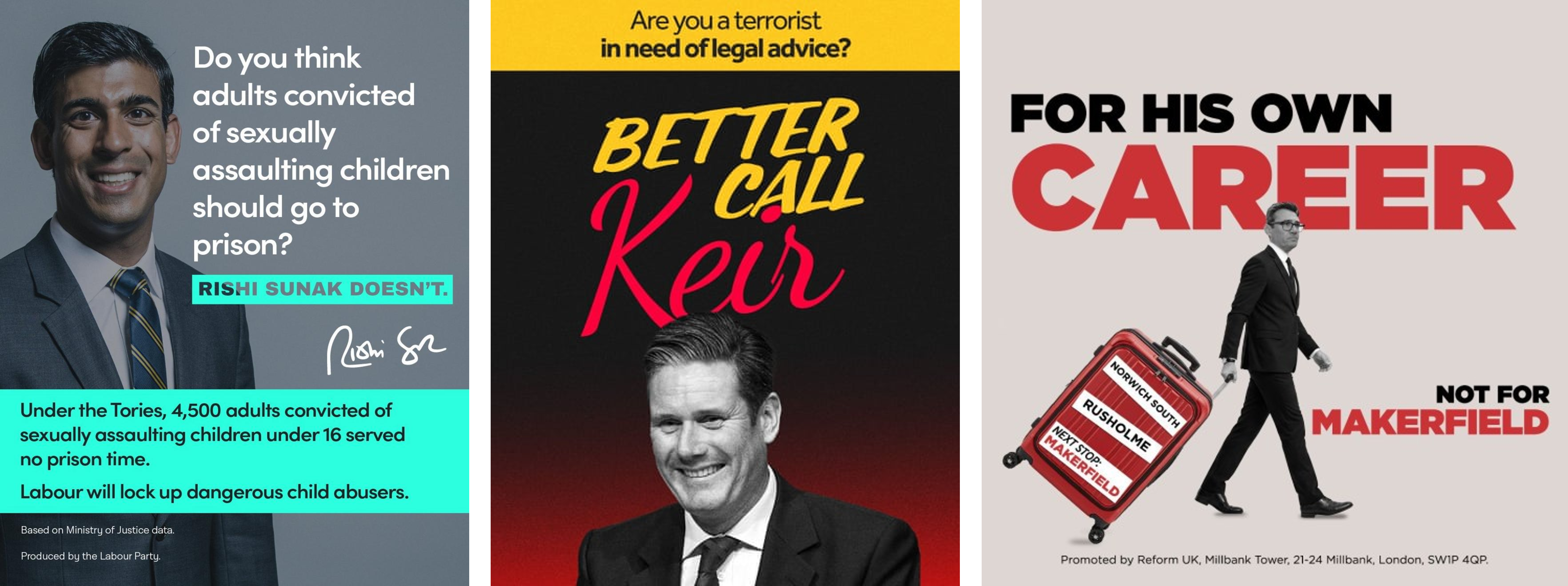
We are potentially reaching the end-game for this in the UK, with the much-vaunted arrival of multi-party politics. Five or even six parties vie for power; Prime Ministerships are shortening; governments are in perpetual campaign mode; new ‘shock’ polls come out daily, etc.
All of the parties within this are effectively engaged in ‘politics as a game’ at the moment. This applies whether they’re a fringe grouping claiming the big two are ‘all the same’, or a mainstream party using the prospect of its primary opponent winning to frighten people into voting.
A more proportional voting system would help this, I think, forcing smaller parties to stop peddling easy answers, and compelling larger parties to create a clearer articulation of what they actually stand for. But many of the answers go beyond this, and come down to political culture.
‘Country before party’
The tonic to ‘politics as a game’ is an ethos which puts ‘country before party’. This is something many politicians claim to do (often shortly before they launch a broadside against opponents for failing to do the same). But what does it actually mean?
Senior politicians are of course competing for a prize which is large – the right to run the country – so we must be realistic. Politics will at points be a contact sport, and passions will run high.
Yet there are a range of practices that are currently business as usual, but which fail absolutely the ‘country before party’ test. A non-exhaustive list is shown below, in no particular order:
Criticising the policy of another party, when you know you don’t have a better plan of your own;
Blaming another party for outcomes you know they’re not responsible for;
Accusing another party of being driven by motivations you know they don’t hold;
Claiming that opponents are planning things you know they don’t intend to do;
Pursuing policies you know are intended not to improve the country, but to create a ‘trap’ for others;
Telling the electorate they are right in an assertion which you know to be factually wrong;
Telling the electorate that a choice which you know to be real is not an either-or dilemma.
Three milder vices I would add here are:
Describing your own parties’ values and ideals in terms no one could disagree with, like ‘decency’ or ‘the many’;
Suggesting that self-serving or corrupt behaviour by individuals is something your party is immune to – or which is restricted to your rivals;
Framing policies based on outcomes (£X more a year in your pocket, Y,000 more nurses) rather than on levers pulled or choices made.
Disowning the practices above would, of course, be entirely voluntary. Without being able to look into the mind of a given politician or strategist, we cannot say what they ‘know’ to be real and whether an argument is truly disingenuous. So I’m not asking that rhetoric be policed or monitored.
But what I would say is that politicians genuinely serious about restoring trust – not just in their own party but in politics as a calling – could privately undertake to follow some of the above steps.
Doing so might not win them much credit at first. But it would cost them far less on the campaign trail then they fear. It would not prevent the heartfelt and sometimes angry debate which is the engine of politics. And it would ultimately help to bounce politics out of the ‘compensatory partisanship’ doom loop in which it’s currently stuck.